Glycine for Sleep: The Amino Acid That Cools You Down
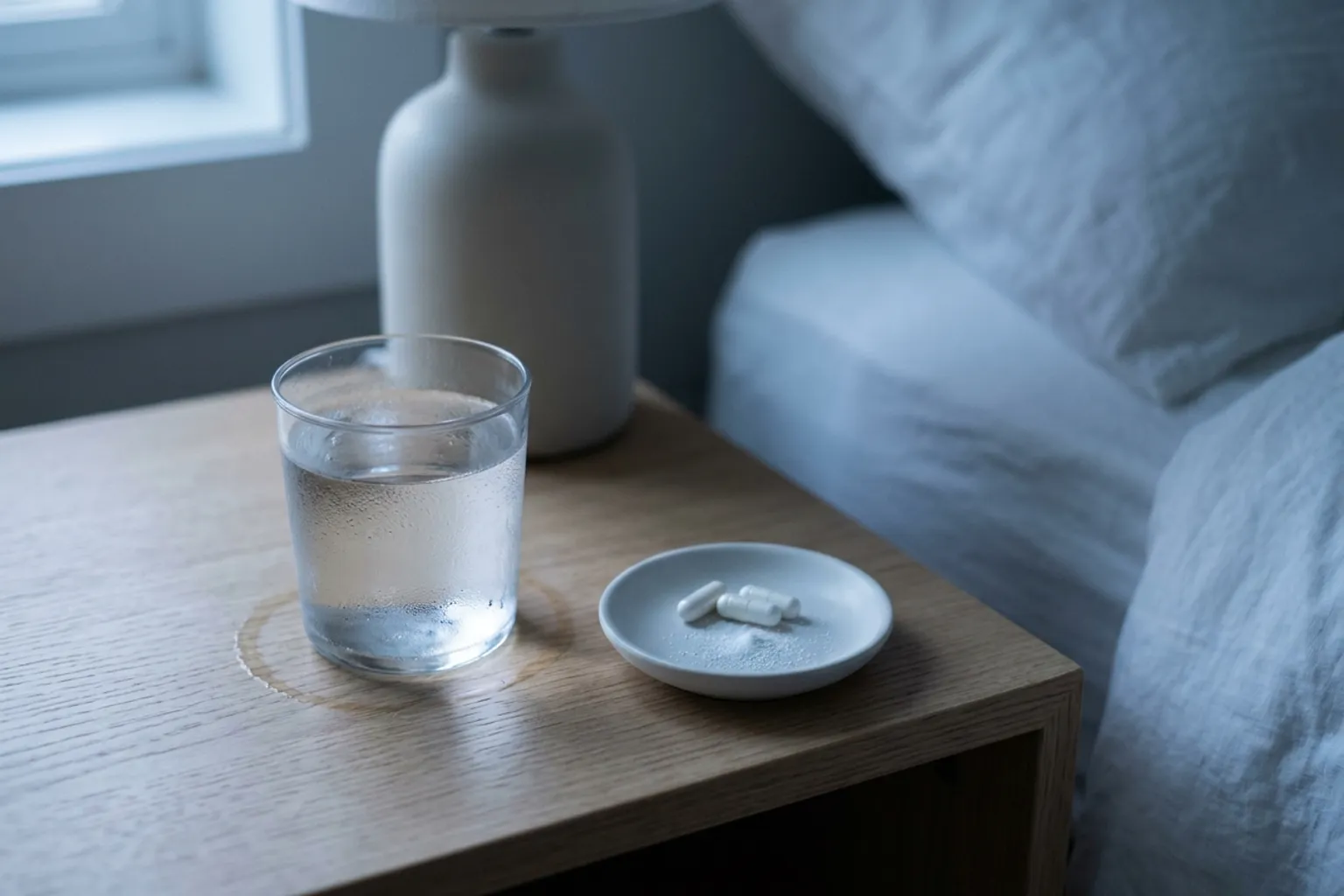
If you want a simple, well studied nudge toward better rest, glycine for sleep is one of the few amino acids with real human trials behind the claim. It is not a sedative and it will not knock you out. What it does is stranger and more interesting: it helps your body do the one thing it has to do before deep sleep can begin, which is cool down.
Your core temperature is supposed to fall by roughly a degree as you drift off. That drop is part of the signal that tells your brain it is night. When it does not happen cleanly, people lie awake feeling tired but somehow not sleepy. Glycine appears to work on exactly that mechanism, and it costs a few cents a night.
Here is what the evidence supports, what it does not, and how to use it.
What Is Glycine?
Glycine is the smallest amino acid, a single carbon flanked by an amine group and an acid group. Your body makes it and uses it everywhere. It is the most abundant amino acid in collagen, which is why it shows up in the structural protein story behind skin and joints, and it doubles as a neurotransmitter in the brain and spinal cord.
That second role is the one that matters here. Glycine is one of the nervous system’s calming signals, and it also interacts with NMDA receptors, the same excitatory receptors that magnesium sits on. If you have ever taken magnesium glycinate at night, the glycine bound to that mineral is part of why the glycinate form is the one recommended for sleep.
Taken on its own before bed, at a few grams, glycine does something you can almost feel: it opens up blood flow to your hands and feet, sheds heat through the skin, and pulls your core temperature down into the range where deep sleep happens.
The Science: What Glycine for Sleep Actually Does
The human data is small but unusually consistent, and it points in one direction. Three grams before bed, tested against placebo, keeps producing the same handful of effects.
Falling into deep sleep faster
The most cited trial put glycine up against objective sleep measurement, not just how people felt.
- The Evidence: A double-blind study published in Sleep and Biological Rhythms gave volunteers with unsatisfactory sleep 3 grams of glycine before bed and recorded their sleep with polysomnography. Glycine shortened the time it took to fall asleep and the time it took to reach slow wave sleep, the deep restorative stage, without distorting the overall architecture of the night. Subjective sleep quality improved alongside the objective numbers.
- Read the study: Glycine ingestion improves subjective sleep quality in human volunteers, correlating with polysomnographic changes
Getting to deep sleep sooner, rather than simply spending more hours in bed, is the useful part. It is the difference between a longer night and a better one.
Waking up clearer
A separate trial looked at the morning after, which is where most people actually judge whether they slept well.
- The Evidence: In a randomized crossover study in the same journal, people who complained about their sleep took 3 grams of glycine before bed and rated how they felt on waking. They reported less fatigue and more liveliness and clear-headedness than on placebo nights. The effect was on the quality of the morning, not just the duration of the sleep.
- Read the study: Subjective effects of glycine ingestion before bedtime on sleep quality
Blunting the cost of a short night
Nobody sleeps perfectly every night. One study asked a more practical question: if your sleep is cut short, does glycine soften the damage the next day?
- The Evidence: Researchers restricted healthy volunteers to 25 percent less sleep than usual for three nights and gave them either 3 grams of glycine or placebo before bed. The glycine group reported significantly less daytime fatigue and performed better on a psychomotor vigilance test, a standard measure of how sharp your reactions are when you are underslept. The benefit was clearest early in the sleep-restricted stretch.
- Read the study: The effects of glycine on subjective daytime performance in partially sleep-restricted healthy volunteers
This is a modest, honest result. Glycine did not make people function as if fully rested. It took some of the edge off a bad night, which is a fair thing to ask of a supplement and no more.
Why the cooling matters
The mechanism was worked out in animals, and it explains why glycine behaves so differently from a sedative.
- The Evidence: A study in Neuropsychopharmacology traced glycine’s sleep effect to the suprachiasmatic nucleus, the brain’s master clock. Glycine acted on NMDA receptors there, widened blood vessels at the skin, and lowered core body temperature. When researchers removed that brain region, the temperature drop and the sleep benefit disappeared together, tying the two directly.
- Read the study: The sleep-promoting and hypothermic effects of glycine are mediated by NMDA receptors in the suprachiasmatic nucleus
That is animal work, so treat it as the proposed explanation rather than proof in people. It fits the human results well: warm hands and feet, a cooler core, and an easier slide into deep sleep.
A Practical Guide: How to Use It
Glycine is refreshingly simple to use, and there is not much to get wrong.
The dose in every one of the human trials was 3 grams, taken about 30 to 60 minutes before bed. Start there. There is no evidence that more works better, and no reason to climb the dose in search of a bigger effect that the studies never found.
Form barely matters, because glycine is glycine. Capsules are the tidy option, and 3 grams is three of the 1,000 mg capsules. The bulk powder is cheaper per serving and dissolves easily in a little water, with a faintly sweet taste that some people actually like. Choose whichever you will remember to take.
One practical note worth keeping straight: taking glycine at bedtime is a different goal from taking magnesium glycinate at bedtime. The magnesium version delivers a small amount of glycine along with the mineral, but not the 3 gram dose the sleep trials used. If sleep is the target, the free amino acid at the studied dose is the cleaner tool.
Safety and Advice
Glycine is about as low risk as a supplement gets. It is a normal component of the protein you eat every day, and your body already makes several grams of it daily, so a 3 gram supplement sits well inside a range your system is built to handle. The trials reported it as well tolerated, with nothing more than occasional mild stomach upset or the drowsiness you are taking it for in the first place.
The usual sensible cautions still apply. If you are pregnant, breastfeeding, or managing a serious condition, check with a clinician before adding anything, and be especially careful if you take medication that acts on the nervous system, since glycine is an active neurotransmitter. People with significant kidney or liver disease should get individual guidance, as they should with any amino acid taken in gram amounts.
What glycine is not is a treatment for a real sleep disorder. If you suspect sleep apnea, or your insomnia is severe and grinding, a few grams of an amino acid is not the answer, and a proper assessment is.
The Bottom Line
Glycine is a cheap, safe amino acid with a small but coherent body of human evidence showing it helps people reach deep sleep sooner and wake up clearer, most likely by nudging core body temperature down the way a good night naturally does. The effects are real and modest, not dramatic, and that is the honest way to sell it.
If you want to try it, take 3 grams about an hour before bed for a week or two and judge the mornings, not just the nights. It pairs sensibly with the basics of a cool, dark room, and it is one of the least expensive experiments in the whole sleep aisle.
This article is for educational purposes only and is not medical advice. Supplements can interact with medications and health conditions, so talk to a qualified healthcare provider before starting anything new.
Common questions
How much glycine should I take for sleep?
The human trials used 3 grams taken about an hour before bed. That is a modest, well tolerated dose and a sensible place to start.
When should I take glycine?
Roughly 30 to 60 minutes before you want to sleep. It works partly by nudging your core body temperature down, and that shift takes a little time.
Does glycine have side effects?
At 3 grams it is very well tolerated. Some people notice mild stomach upset or a bit of drowsiness. It is a normal part of dietary protein, so the safety margin is wide.
How is glycine different from a sleeping pill?
It does not sedate you the way a benzodiazepine does. In the trials it helped people reach deep sleep faster and feel clearer the next morning, without the grogginess that hypnotics often leave behind.