The Real Ergothioneine Benefits, and What Isn't Proven Yet
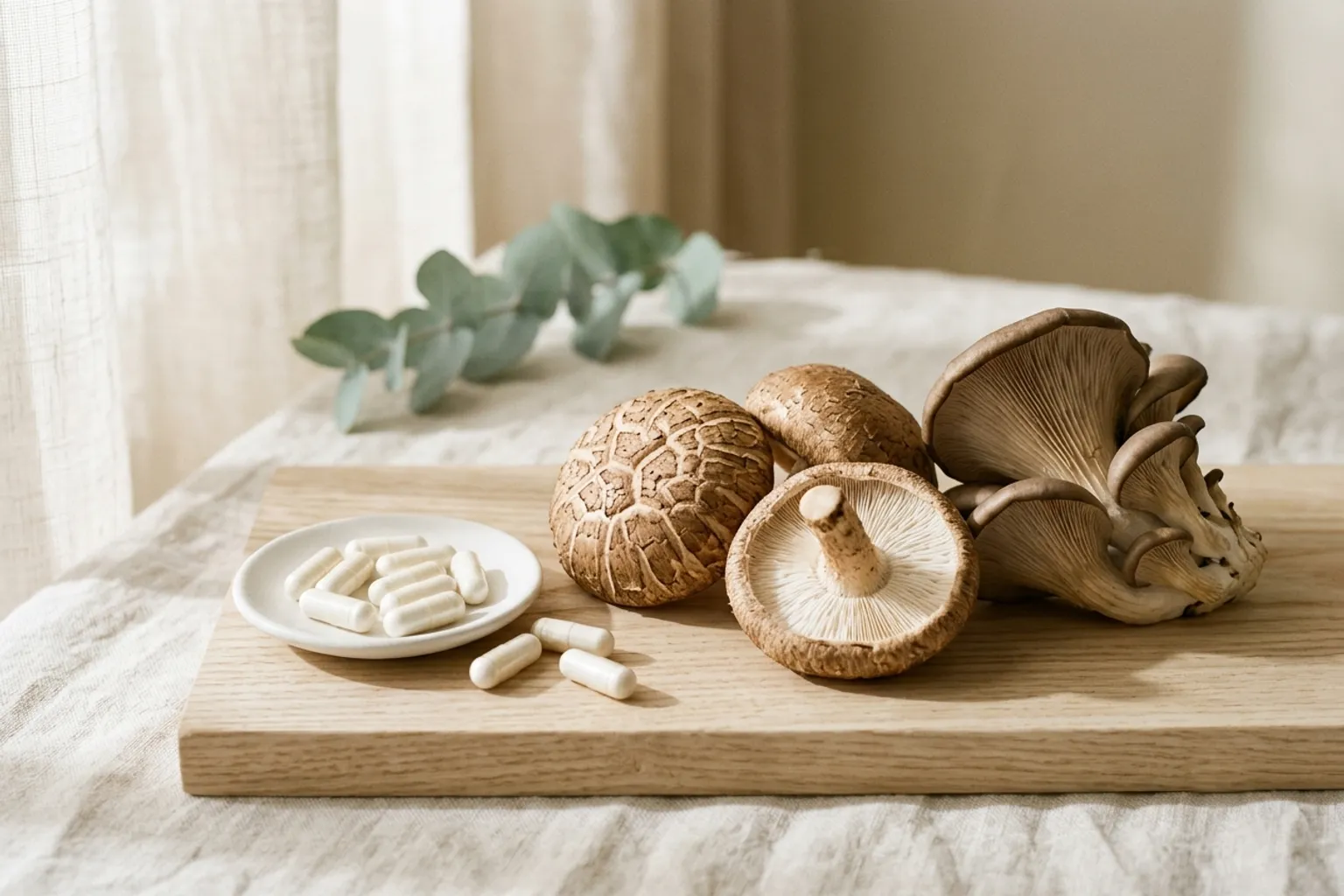
Most rundowns of ergothioneine benefits open with a strange fact: your body cannot make this compound, yet it built a dedicated transporter just to hold onto every molecule it gets from food. Evolution does not usually spend energy hoarding something useless.
Ergothioneine comes almost entirely from mushrooms, and it ends up concentrated in exactly the tissues that take the most oxidative punishment: red blood cells, the liver, the lens of the eye, the brain. Researchers have started calling it a longevity vitamin, a nutrient that is not strictly required to survive but may matter a great deal for how well you age.
The label carries a lot of weight, though. Some of the human evidence is genuinely interesting. Some of it is the kind of observational data that gets oversold in a supplement ad. Here is what actually holds up.
What Is Ergothioneine?
Ergothioneine is a sulfur-containing amino acid made by fungi and certain bacteria. Humans and other animals cannot synthesize it at all, so every bit in your body traces back to your diet, and mushrooms supply the overwhelming majority of it. Oyster, shiitake, and king oyster mushrooms carry the most.
What sets it apart from an ordinary antioxidant is how the body treats it. Your cells express a specific transporter, SLC22A4 (long known as OCTN1), whose main job appears to be pulling ergothioneine inside and keeping it there. That transporter shows up most strongly in tissues under constant oxidative and inflammatory stress. Inside the cell, ergothioneine concentrates in the mitochondria, the same energy machinery that CoQ10 works to protect, at levels far above what circulates in blood. A body does not build a precise delivery system for a molecule it has no use for, which is the central argument for taking ergothioneine seriously.
Its chemistry is unusual too. Unlike many antioxidants that get used up in a single reaction, ergothioneine is remarkably stable and appears to act more like a standing reserve, stepping in during oxidative stress rather than degrading on contact.
The Science: Which Ergothioneine Benefits Hold Up?
The human evidence sorts into three uneven piles: one large observational cohort with striking numbers, one recent randomized trial with modest but real signals, and one small safety-focused pilot in people already at risk. Read in that order, the picture stays honest.
Higher blood levels track with lower mortality
The strongest human data on ergothioneine is also the hardest to act on, because it is a correlation, not a controlled experiment.
- The Evidence: In a prospective cohort published in Heart in 2020, researchers measured plasma metabolites in 3,236 adults from the Swedish Malmö Diet and Cancer study and followed them for a median of 21.4 years. Higher ergothioneine was independently associated with lower risk of coronary disease, cardiovascular mortality, and all-cause mortality, with hazard ratios per one standard deviation of roughly 0.85, 0.79, and 0.86. Ergothioneine was also the metabolite most tightly linked to a produce-and-mushroom-rich eating pattern.
- Read the study: Ergothioneine is associated with reduced mortality and decreased risk of cardiovascular disease
That is a large, long, well-run cohort, and the direction of the association is consistent with everything else known about the molecule. But people with high ergothioneine tend to eat more whole foods overall, so some of the benefit almost certainly belongs to the diet rather than the compound. This tells you low levels are a warning sign worth heeding. It does not prove a capsule fixes the risk.
Supplements nudged memory, reaction time, and sleep in older adults
The observational data begged for a real trial. The first sizable one arrived recently, and its results are encouraging without being dramatic.
- The Evidence: A 16-week randomized, double-blind, placebo-controlled trial published in Nutraceuticals in 2025 gave 147 adults aged 55 to 79 with subjective memory complaints either 10 mg or 25 mg of ergothioneine a day or placebo. Reaction time improved against placebo, at week 4 in the 10 mg group and week 16 in the 25 mg group, and self-rated prospective memory improved in a dose-dependent way while the placebo group drifted the other direction. Participants also reported better sleep quality.
- Read the study: The Effect of Ergothioneine Supplementation on Cognitive Function, Memory, and Sleep in Older Adults with Subjective Memory Complaints: A Randomized Placebo-Controlled Trial
This is one trial, the effects were on specific measures rather than every cognitive domain, and the participants were older adults who already noticed slipping memory, so the findings may not transfer to a healthy 35-year-old. Still, it moves ergothioneine from “interesting blood marker” toward “does something measurable when you take it,” which is a meaningful step for a longevity compound.
It held up safely in people already at cognitive risk
A benefit is only useful if the compound is safe to take for a long time, and this is where ergothioneine looks best.
- The Evidence: A one-year pilot study led by researchers at the National University of Singapore, published in the Journal of Alzheimer’s Disease in 2024, gave older adults with mild cognitive impairment 25 mg of ergothioneine three times a week. The main goal was to test safety and feasibility, and the supplement was well tolerated with no adverse effects, alongside early signals pointing toward slower cognitive decline that a larger trial will need to confirm.
- Read the study: Investigating the efficacy of ergothioneine to delay cognitive decline in mild cognitively impaired subjects: A pilot study
A clean safety record in a fragile population, taken for a full year, is exactly what you want before betting on a compound for the long haul. It is a pilot, though. The efficacy question is genuinely open, and the honest read is “promising and safe,” not “proven to protect the brain.”
A Practical Guide: How to Use It
Start with the obvious lever most people skip: mushrooms. They are the dominant dietary source of ergothioneine, and cooking does not destroy much of it. A regular mushroom habit measurably raises your blood levels, which is more than can be said for most supplement claims. Oyster and shiitake are among the richest.
If you want the amounts used in research, a supplement is the reliable route. The human trials landed between 5 and 25 mg a day, and the large cognitive study specifically tested 10 mg and 25 mg. The product this post links to sits at 25 mg, at the top of that studied range.
Timing barely matters, and here ergothioneine is unusual. Because your tissues actively retain it, the compound sticks around for weeks rather than washing out in a day. That means you are topping up a reserve, not chasing a daily peak, so a consistent dose with or without food is all you need. What matters is staying with it. The trials ran for months, so treat this as a slow accumulation rather than something you feel by the weekend.
Safety and Advice
Ergothioneine has one of the friendliest safety profiles in the longevity aisle, which stands to reason for a molecule your body deliberately stockpiles. Across the human trials so far, doses up to 25 mg a day produced no adverse effects, and regulators in several regions have cleared it as a food ingredient at comparable amounts. There is no established toxic threshold at the doses people actually use.
The usual caveats still apply. Long-term safety data in healthy people taking it for years does not exist yet, simply because the compound is new to supplement shelves. People who are pregnant or breastfeeding should skip it for lack of specific data, and anyone on prescription medication or managing a health condition should check with a clinician first. None of this flags ergothioneine as risky. It reflects how early the human research still is.
The Bottom Line
Ergothioneine is one of the more scientifically grounded bets in the longevity aisle, with a plausible mechanism, a body built to hoard it, and a large cohort tying higher levels to living longer. The catch is that the interventional proof is early: one solid cognitive trial with modest effects and a year-long safety pilot, against a mortality signal that is observational and partly a story about eating well. That gap between promise and hard proof is the same one that hangs over the rest of the longevity-compound shelf.
If you want in, the cheapest move is to eat more mushrooms. If you want the researched dose, 5 to 25 mg a day is well tolerated and easy to sustain. Treat it as a low-risk wager on strong biology, and keep your expectations tied to what the trials have actually shown.
This article is for educational purposes only and is not medical advice. Supplements can interact with medications and health conditions, so talk to a qualified healthcare provider before starting anything new.
Common questions
How much ergothioneine should I take?
Human trials have used between 5 and 25 mg a day, and the largest cognitive study tested 10 mg and 25 mg doses. A regular serving of mushrooms supplies only a few milligrams, so a 5 to 25 mg capsule is a reasonable way to reach the amounts used in research.
How long does ergothioneine take to work?
The body holds onto ergothioneine for weeks rather than clearing it in hours, so levels build gradually with consistent use. The cognitive trials ran for 16 weeks and the mild cognitive impairment pilot ran for a year, so judge it over months, not days.
Does ergothioneine have side effects?
It has one of the cleanest safety records of any longevity supplement. Human trials at doses up to 25 mg a day reported no adverse effects, which fits its role as a compound your tissues already accumulate on purpose.
Can I get enough ergothioneine from food?
Mushrooms are by far the richest source and account for the large majority of dietary intake. Eating them regularly, especially oyster and shiitake, raises your blood levels, but a supplement gives you a fixed dose without needing mushrooms every day.