Does Resveratrol Actually Work, or Was It the Wine?
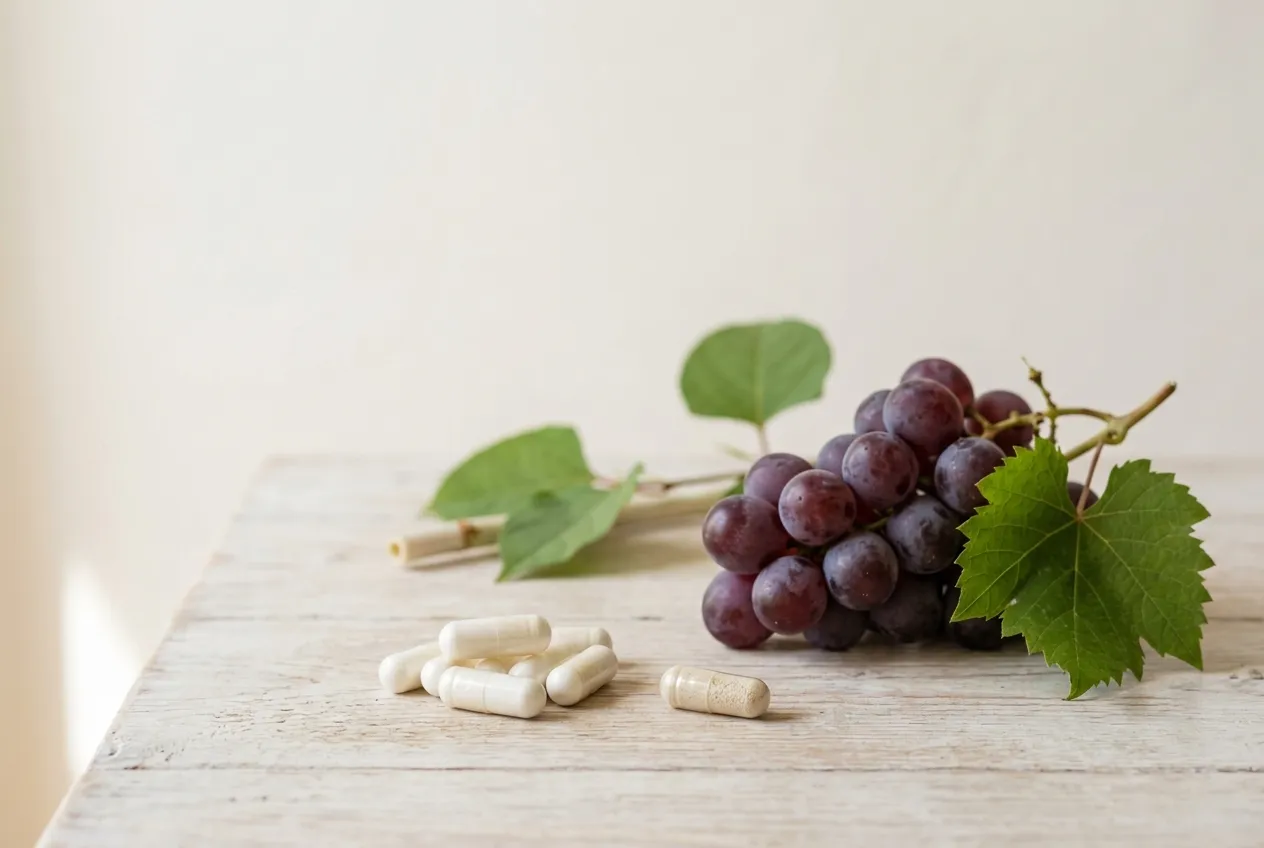
Does resveratrol actually work, or did a glass of red wine just get very good marketing? For twenty years this molecule has carried the story that people who drink red wine have healthier hearts, and that resveratrol is the reason. It became the first celebrity of the longevity world.
The trouble with that story is arithmetic. To match the dose used in the animal studies that made resveratrol famous, you would have to drink dozens of bottles of wine a day. The mouse data was real and genuinely exciting. The leap from mouse to wineglass to human is where the hype outran the science.
So it is worth doing what the marketing never did: separate what resveratrol has actually done in human trials from what a red-wine ad wants you to believe.
What Is Resveratrol?
Resveratrol is a polyphenol, a plant defense compound that grapes, peanuts, and Japanese knotweed produce when they are under stress from injury or fungus. Most supplements use trans-resveratrol, the active form, extracted from knotweed rather than grapes because the yield is far higher.
Its fame comes from the lab. Resveratrol can switch on a family of enzymes called sirtuins, especially SIRT1, which help regulate how cells respond to stress and energy scarcity. Sirtuin activation is one of the pathways triggered by calorie restriction, the most reliable way to extend lifespan in animals, so a molecule that flips the same switch without the starving looked like a shortcut. In yeast, worms, flies, and mice it extended lifespan or improved metabolic health across several studies.
Here is the catch that shadows everything else. Resveratrol is barely bioavailable. You absorb it, but your gut and liver conjugate it into sulfate and glucuronide metabolites within an hour, so less than 1 percent of what you swallow reaches the bloodstream as intact resveratrol. Whether those metabolites do the useful work, or whether the parent compound needs to get through, is still an open question. It is the reason a lot of dazzling cell-culture findings never translate into anything you can feel.
The Science: Does Resveratrol Actually Work?
The honest answer is that resveratrol does measurable things in specific groups of people, and much less in everyone else. The human trials are smaller and messier than the mouse hype implied. But a few results hold up. Here is what survives a real trial.
Blood sugar control, mostly in people with diabetes
The metabolic angle is where resveratrol has its most consistent human data, and the nuance is the whole point.
- The Evidence: A meta-analysis of 11 randomized controlled trials published in the American Journal of Clinical Nutrition pooled results across diabetic and non-diabetic participants. In people with type 2 diabetes, resveratrol significantly lowered fasting glucose, by roughly 35 mg/dL, and improved insulin sensitivity. In people without diabetes, it moved none of the glycemic markers at all.
- Read the study: Effect of resveratrol on glucose control and insulin sensitivity: a meta-analysis of 11 randomized controlled trials
That split is the most useful thing to know about resveratrol. If your fasting glucose is already normal, the metabolic benefit largely evaporates. If your blood sugar runs high, there is a real signal. It is not a replacement for the medication and diet that treat diabetes, but as an add-on the evidence is better than for most of the supplement aisle.
Cognition and blood flow in postmenopausal women
The most interesting sustained work on resveratrol comes from one research group in Australia studying postmenopausal women, a group whose falling estrogen leaves blood vessels stiffer and cognition more exposed.
- The Evidence: In a 24-month randomized, double-blind, placebo-controlled crossover trial, 125 postmenopausal women took 75 mg of trans-resveratrol twice a day or placebo. The resveratrol phase significantly improved overall cognitive performance and measures of cerebrovascular function compared with placebo, alongside better markers of blood-vessel health.
- Read the study: Long-term effects of resveratrol on cognition, cerebrovascular function and cardio-metabolic markers in postmenopausal women
An earlier trial from the same group pointed the same way over a shorter window.
- The Evidence: A 14-week randomized, placebo-controlled study in Nutrients gave 80 postmenopausal women 75 mg of trans-resveratrol twice a day. It produced about a 17 percent increase in the brain’s blood-flow response to a mental task, along with improvements in cognitive performance and self-reported mood.
- Read the study: Effects of Resveratrol on Cognitive Performance, Mood and Cerebrovascular Function in Post-Menopausal Women
Read the population carefully. This is postmenopausal women, and the effect may lean on resveratrol’s action on blood vessels, which happen to be under particular strain after menopause. It is the strongest cognition case resveratrol has, and it is also specific. Whether a healthy 35-year-old would notice anything is untested. Like quercetin, another polyphenol that fights its own poor absorption, resveratrol tends to show its hand in the people who need it most.
Higher doses nudge blood pressure down
Cardiovascular benefit was the entire premise of the red-wine story, so it is fair to ask whether the pill delivers.
- The Evidence: A meta-analysis of randomized controlled trials found that resveratrol had no significant effect on blood pressure overall, but a higher-dose subgroup, at 150 mg a day or more, showed a significant drop in systolic pressure of nearly 12 mmHg. Lower doses did nothing, and diastolic pressure did not move.
- Read the study: Effect of resveratrol on blood pressure: a meta-analysis of randomized controlled trials
That is a genuinely useful effect on systolic pressure, but only at doses far above what any glass of wine contains, which quietly demolishes the original marketing. It also rests on a modest number of trials, so treat it as promising rather than settled.
A Practical Guide: How to Use It
Start with the form. You want trans-resveratrol, the active isomer, and any reputable supplement will say so on the label. The product this post links to supplies 600 mg of trans-resveratrol per capsule, which sits well above the 150 mg mark where the blood-pressure and metabolic effects appeared.
The doses that worked in human trials ran from 150 mg a day in the postmenopausal cognition studies up to 500 mg or more in the metabolic ones. Somewhere in the 150 to 500 mg range is a sensible target. There is no good evidence that pushing far past that does anything except cost more.
Take it with a meal that has some fat in it. Resveratrol is fat-soluble, and food slows the gut metabolism that otherwise shreds it, so absorption improves compared with an empty stomach. Consistency beats timing, because the studies that found benefits ran for months. If you are hoping resveratrol does something for your metabolism or your blood pressure, give it eight to twelve weeks before you decide.
One thing not to bother with: chasing resveratrol through red wine. The dose is trivial, and the alcohol works against every benefit you are after.
Safety and Advice
Resveratrol has a reassuring safety record at supplement doses. Human trials up to 500 mg a day, and shorter studies well above that, have been generally well tolerated. The most common complaint is digestive, and it clusters at the extremes: grams-per-day doses can bring cramping, nausea, or loose stools, which is one more reason not to megadose.
The real caution is interactions. Resveratrol can inhibit some drug-metabolizing enzymes and has mild blood-thinning activity, so it can amplify anticoagulants like warfarin and antiplatelet drugs. If you take blood thinners, have surgery scheduled, or are on medication cleared by the liver, talk to a doctor first. It also has weak estrogen-like activity, so anyone with a hormone-sensitive condition should be cautious and seek medical advice. Pregnant and breastfeeding women should skip it for lack of safety data.
None of this makes resveratrol dangerous. It makes it a real compound with real pharmacology, which is exactly why your dose and your medication list matter.
The Bottom Line
So, does resveratrol actually work? In the specific places the human trials looked, yes, modestly: better blood sugar control in people with diabetes, sharper cognition and blood flow in postmenopausal women, and lower systolic pressure at higher doses. The red-wine longevity fairy tale that made it famous is not one of those places, and the bioavailability problem keeps a ceiling on the whole story.
If you fit one of those groups, 150 to 500 mg of trans-resveratrol a day with a fatty meal is a low-risk, evidence-backed thing to try for a couple of months. If you are a healthy adult expecting it to stretch your lifespan the way it did a mouse’s, the honest verdict is that the proof is not in yet, the same gap between promise and evidence that hangs over much of the longevity-compound shelf.
This article is for educational purposes only and is not medical advice. Supplements can interact with medications and health conditions, so talk to a qualified healthcare provider before starting anything new.
Common questions
How much resveratrol should I take a day?
The human trials that found benefits used roughly 150 to 500 mg of trans-resveratrol a day. The postmenopausal cognition studies used 150 mg split into two 75 mg doses, and the metabolic trials often used more. There is no good evidence that going far above 500 mg adds anything.
Can I get enough resveratrol from red wine?
No. A glass of red wine contains only a milligram or two, far below the 150 mg and up that the trials used. You would need dozens of bottles a day to match a supplement, and the alcohol works against the benefits you are after.
Does resveratrol have side effects?
At normal supplement doses it is generally well tolerated. The main problem shows up at very high grams-per-day doses, which can cause cramping, nausea, or loose stools. It can also interact with blood thinners, so check with a doctor if you take them.
How long does resveratrol take to work?
Longer than a few days. The trials that saw benefits ran for months, from 14 weeks up to two years, so give it at least eight to twelve weeks of consistent daily use before you judge it.