Broccoli Sprout Supplements Work, If the Myrosinase Survived
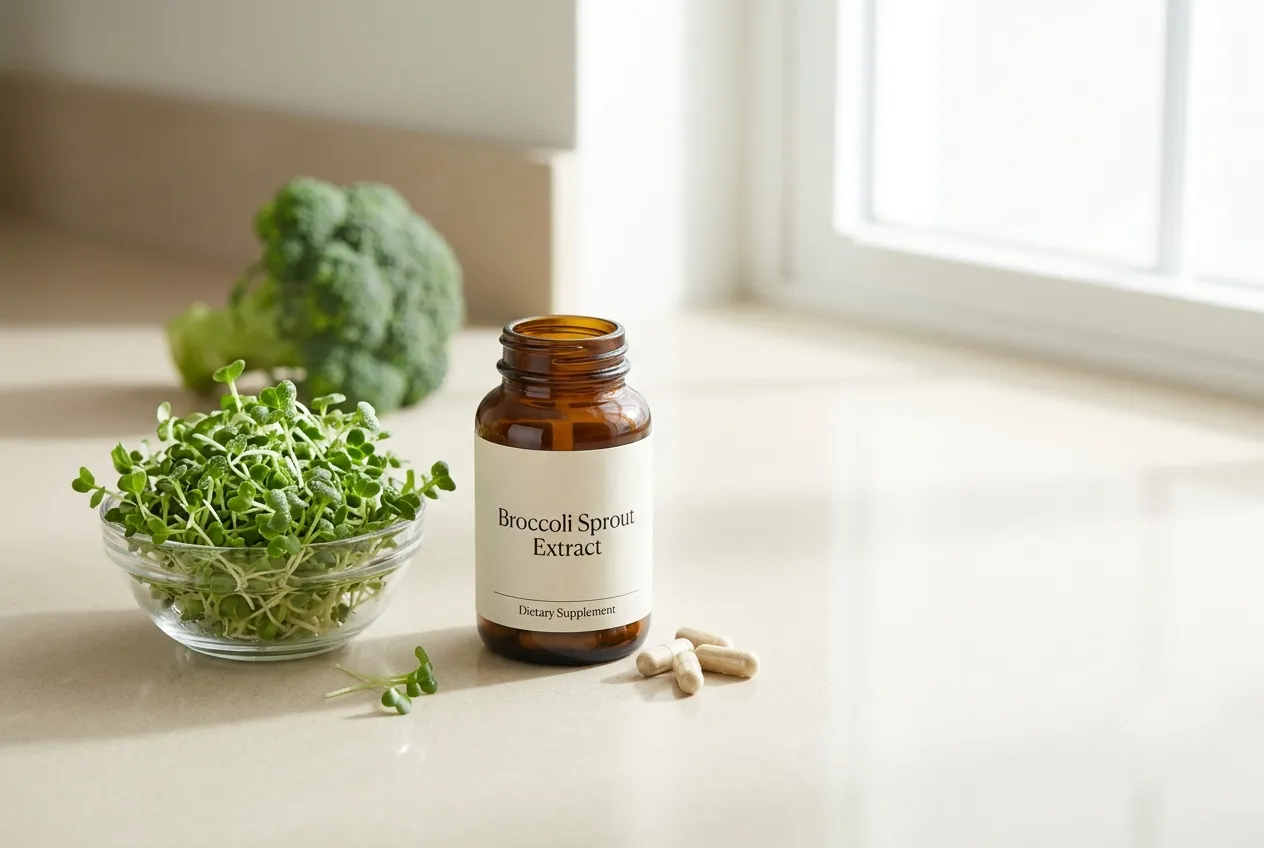
Whether broccoli sprout supplements work comes down to a single chemical reaction, and most of them get that reaction wrong. Sulforaphane is one of the most researched plant compounds in the human diet, with real clinical trials behind it rather than test-tube promises. Yet the way it is grown, processed, and sold means a lot of what sits on shelves delivers a fraction of what the studies used.
That gap is the whole story. Broccoli does not actually contain much sulforaphane. It carries a stable precursor and an enzyme that turns that precursor into the active compound, and the two only meet when the plant is damaged. Cook the broccoli, or process the extract with heat, and you can lose the enzyme entirely.
So before you decide whether sulforaphane deserves a place in your routine, it helps to understand what the compound does in people, and why the label on the bottle matters more here than for almost anything else.
What Is Sulforaphane?
Sulforaphane is a sulfur-rich compound found in cruciferous vegetables, most concentrated in broccoli and especially in young broccoli sprouts. It belongs to a family called isothiocyanates, and it is best understood as the finished product of a two-part system rather than an ingredient you eat directly.
The first part is glucoraphanin, a stable storage molecule the plant keeps on hand. The second is myrosinase, an enzyme stored separately. When you chew raw broccoli or crush a sprout, the two mix, myrosinase acts on glucoraphanin, and sulforaphane is created on the spot. Heat destroys myrosinase, which is why steamed broccoli yields far less sulforaphane than raw, and why a poorly made extract can be almost inert.
Once absorbed, sulforaphane does something unusual. It activates a cellular pathway called Nrf2, sometimes described as a master switch for the body’s own defensive machinery. Rather than acting as an antioxidant itself, it prompts your cells to ramp up production of their own protective and detoxifying enzymes. That indirect, switch-flipping mechanism is why its effects can outlast the compound’s short stay in the bloodstream.
The Science: Do Broccoli Sprout Supplements Work in People?
Sulforaphane has been tested in genuine human trials, not just cell cultures, which puts it ahead of most compounds in the botanical aisle. The evidence is strongest for a handful of specific outcomes, and honest about where it stops.
It lowered fasting blood sugar
The most striking human result came from a study that used gene-expression matching to hunt for a compound that could counter the pattern seen in type 2 diabetes. Sulforaphane came out on top, and the researchers took it all the way into people.
- The Evidence: In a trial published in Science Translational Medicine, obese patients with dysregulated type 2 diabetes took a concentrated broccoli sprout extract for 12 weeks. The extract was well tolerated and reduced fasting blood glucose compared with placebo, apparently by dialing down the liver’s overproduction of glucose through the Nrf2 pathway, a different mechanism than the standard drug metformin uses.
- Read the study: Sulforaphane reduces hepatic glucose production and improves glucose control in patients with type 2 diabetes
This is a real effect on a hard number, which is rare for a supplement. It is not a diabetes cure, and the benefit was modest and clearest in people who started with poor control. But fasting glucose is a genuine cardiometabolic marker, and moving it at all with a food-derived compound is notable.
It cooled markers of inflammation
Chronic low-grade inflammation sits underneath a lot of age-related disease, and sulforaphane’s Nrf2 activity has a quieting effect on it. The clearest human read comes from a dose-comparison trial.
- The Evidence: In a randomized, double-blind, placebo-controlled study, 81 people with type 2 diabetes took broccoli sprout powder or placebo for four weeks. The groups taking the higher-sulforaphane powder saw a significant drop in high-sensitivity C-reactive protein, a standard blood marker of inflammation tied to cardiovascular risk, of roughly 16 to 20 percent.
- Read the study: Effects of broccoli sprout with high sulforaphane concentration on inflammatory markers in type 2 diabetic patients
Read that as directional, not dramatic. Changes in inflammatory markers are not the same as changes in heart attacks, and the study was short and in a specific population. Still, it lines up with the mechanism and with the blood-sugar data, which is the kind of consistency that builds a case. Sulforaphane works through some of the same defensive chemistry that NAC supports by rebuilding glutathione, just approached from a different angle.
It helped the body clear airborne pollutants
One of the more elegant trials tested whether sulforaphane could speed up the body’s disposal of common toxins, using people living with heavy air pollution.
- The Evidence: In a 12-week randomized trial in Qidong, China, published in Cancer Prevention Research, nearly 300 adults drank a broccoli sprout beverage or placebo daily. Those on the real beverage excreted significantly more of the detoxified byproducts of two airborne pollutants, benzene up by 61 percent and acrolein by 23 percent, and the effect started fast and held steady across the study.
- Read the study: Rapid and Sustainable Detoxication of Airborne Pollutants by Broccoli Sprout Beverage: Results of a Randomized Clinical Trial in China
The mechanism is the interesting part. Sulforaphane did not block exposure. It nudged the body to conjugate and flush the pollutants faster, using the same glutathione-based clearance system that antioxidant defenses like CoQ10 help protect from oxidative damage.
It reduced gut colonization by H. pylori
Sulforaphane also has direct antibacterial activity, and one target is Helicobacter pylori, the stomach bug behind most ulcers and a good deal of chronic gastritis.
- The Evidence: In a study in Cancer Prevention Research, infected volunteers ate about 70 grams of fresh broccoli sprouts daily for eight weeks. Compared with a placebo sprout, the broccoli group showed reduced markers of H. pylori colonization and lower measures of stomach inflammation, effects that faded once they stopped eating the sprouts.
- Read the study: Dietary Sulforaphane-Rich Broccoli Sprouts Reduce Colonization and Attenuate Gastritis in Helicobacter pylori-Infected Mice and Humans
Note the reversal when the sprouts stopped. Sulforaphane suppressed the bug rather than eradicating it, so this is a support strategy alongside proper medical treatment, not a replacement for the antibiotics that actually clear an infection.
A Practical Guide: How to Use It
Here is where most of the money gets wasted. The dose that matters is delivered sulforaphane, and that depends entirely on whether your source can complete the glucoraphanin-to-sulforaphane conversion.
Fresh broccoli sprouts are the gold standard because they carry both the precursor and active myrosinase, and they contain many times more glucoraphanin than mature broccoli. If you buy an extract, the label game is what to watch. A product can boast a high glucoraphanin number and still deliver little sulforaphane if the myrosinase was cooked out during processing. Research comparing food and supplement forms found bioavailability can drop dramatically without active enzyme present.
- The Evidence: A controlled study on bioavailability found that sulforaphane absorption from glucoraphanin-rich sources is largely governed by whether active myrosinase is present, with heat-inactivated forms yielding far less than fresh, enzyme-intact ones.
- Read the study: Sulforaphane Bioavailability from Glucoraphanin-Rich Broccoli: Control by Active Endogenous Myrosinase
Practically, look for an extract that either preserves or adds active myrosinase, or standardizes to sulforaphane yield rather than glucoraphanin alone. If you eat sprouts instead, chewing thoroughly or briefly crushing them helps the enzyme do its work. Human trials have used the equivalent of roughly 40 to 150 micromoles of sulforaphane a day, well beyond a casual serving of vegetables. Take it with food, and be patient: the Nrf2 effects build over weeks rather than delivering a same-day feeling.
Safety and Advice
Sulforaphane comes from a vegetable people have eaten forever, so its baseline safety is reassuring. Across the trials above, lasting from weeks to months, it was generally well tolerated, with mild digestive complaints like gas or bloating the most common issue.
The caveats are about concentration and gaps in data. Daily high-dose extracts are a newer thing than eating broccoli, and their long-term safety is not fully charted. People who are pregnant or breastfeeding should avoid concentrated supplements for lack of data. If you have a thyroid condition, note that cruciferous compounds can theoretically affect thyroid function at high intakes, so raise it with your doctor. And as with anything that acts on your metabolism, if you take medication for blood sugar or any chronic condition, check before adding it, since a real effect on glucose is a real interaction to plan around.
The Bottom Line
Sulforaphane is one of the few plant compounds with legitimate human trials showing measurable effects, on blood sugar, inflammatory markers, pollutant clearance, and stomach bacteria. The results are meaningful but modest, and none of them make it a treatment for anything on its own.
The catch that trips up most buyers is delivery. If you want the effects the studies documented, fresh broccoli sprouts are the surest source, and if you go with a capsule, buy one that guarantees active myrosinase or a real sulforaphane yield rather than a big glucoraphanin number that never converts. Start there, give it a few weeks, and judge it on the merits rather than the hype.
This article is for educational purposes only and is not medical advice. Supplements can interact with medications and health conditions, so talk to a qualified healthcare provider before starting anything new.
Common questions
How much sulforaphane should I take?
Human trials have used a wide range, roughly 40 to 150 micromoles of sulforaphane a day, which is far more than a normal serving of cooked broccoli provides. Most capsules are dosed in micrograms of sulforaphane or milligrams of glucoraphanin, so check which number is on the label and start at the lower end.
Why does myrosinase matter so much?
Broccoli does not contain much sulforaphane directly. It stores a precursor called glucoraphanin, which only converts to sulforaphane when the enzyme myrosinase is present. Cooking destroys myrosinase, and many extracts are made from heat-treated broccoli, so a product that lists high glucoraphanin but no active myrosinase can deliver very little actual sulforaphane.
Is sulforaphane safe and does it have side effects?
It has been well tolerated in trials lasting weeks to months, with mild digestive complaints like gas or bloating being the most common issue. It is a food-derived compound, so serious effects are rare, but the long-term safety of concentrated daily supplements is not fully mapped.
Who should avoid sulforaphane supplements?
People who are pregnant or breastfeeding should skip concentrated extracts for lack of safety data, and anyone with thyroid concerns or on prescription medication should check with a doctor first. Broccoli sprouts as food are fine for most people.