Quercetin Benefits That Actually Show Up in Human Trials
Most lists of quercetin benefits open with allergies, and that is the one use where the human proof is thinnest. The more interesting evidence sits elsewhere: a small but real drop in blood pressure, eased joint symptoms in rheumatoid arthritis, and a starring role in the trial that first cleared aging cells out of living people.
Quercetin is a plant pigment, the yellow flavonoid that colors onion skins and gives capers their sharp taste. Your diet already contains it. The real question is whether concentrating it into a capsule does anything a good plate of vegetables does not.
The honest answer is mixed. It is worth walking through carefully, because quercetin gets sold on a long list of promises and only a few of them have solid trials behind them.
What Is Quercetin?
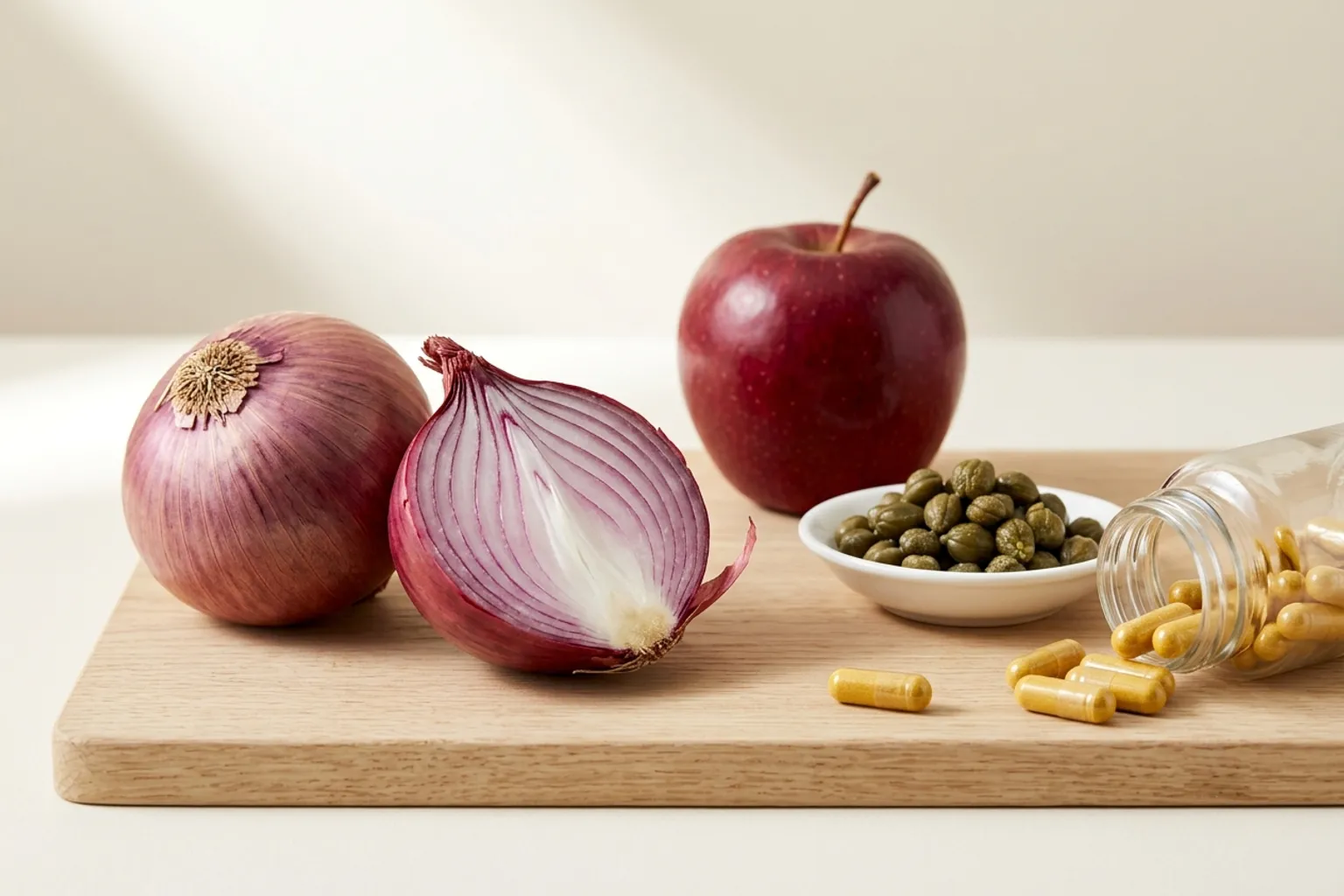
Quercetin is a flavonoid, one of the colorful antioxidant compounds found throughout the plant world. The richest dietary sources are capers, red onions, apples with the skin on, berries, and leafy greens. A varied diet supplies somewhere in the range of tens of milligrams a day, well below the doses used in research.
That gap exists for a reason. Quercetin is poorly water soluble and poorly absorbed, and the liver clears it quickly, so only a fraction of what you swallow reaches your bloodstream in active form. This is the single most important fact about supplementing it, and it shapes every practical decision later on.
Mechanistically, quercetin does a few distinct things. It mops up reactive molecules as a direct antioxidant. It stabilizes mast cells, the immune cells that release histamine, which is the basis for its reputation as a natural antihistamine. And it interferes with the survival signals that keep worn-out “senescent” cells alive, which is why longevity researchers pair it with a prescription drug to clear those cells out. Those three actions map onto the three areas where the human evidence is worth taking seriously.
The Science: Which Quercetin Benefits Hold Up?
Quercetin has been tested in real randomized human trials, not just cell cultures, which already puts it ahead of much of the botanical aisle. The results are modest and specific, and the honest reading matters more than the marketing.
It nudged blood pressure down
The most consistent human finding is a small reduction in blood pressure, pooled across multiple controlled trials rather than resting on any single study.
- The Evidence: A systematic review and meta-analysis in the Journal of the American Heart Association combined seven randomized controlled trials covering 587 participants. Quercetin supplementation lowered systolic blood pressure by about 3.0 mmHg and diastolic by about 2.6 mmHg compared with placebo, with the clearest effect in trials lasting at least eight weeks.
- Read the study: Effects of Quercetin on Blood Pressure: A Systematic Review and Meta-Analysis of Randomized Controlled Trials
A three-point drop will not replace a blood pressure medication, and it is easy to oversell. But it is a real effect on a hard number, measured across many people, and small shifts in blood pressure across a population do matter for long-term cardiovascular risk.
It eased joint symptoms in rheumatoid arthritis
Quercetin’s anti-inflammatory reputation is broad, but the cleanest human joint data comes from a focused trial in people with an inflammatory condition.
- The Evidence: A double-blind, randomized controlled trial in the Journal of the American College of Nutrition gave 50 women with rheumatoid arthritis either 500 mg of quercetin a day or placebo for eight weeks. The quercetin group had significant reductions in early morning stiffness, morning pain, and after-activity pain, along with improvements in disease activity scores and a marker of inflammation, TNF-alpha.
- Read the study: The Effect of Quercetin on Inflammatory Factors and Clinical Symptoms in Women with Rheumatoid Arthritis: A Double-Blind, Randomized Controlled Trial
This was a small, short study in a specific patient group, so read it as promising rather than definitive. It lines up with the mechanism, though, and with the broader anti-inflammatory chemistry that sulforaphane works through to lower C-reactive protein.
It helped clear senescent cells, alongside a prescription drug
This is the result that put quercetin on the longevity map, and it needs careful framing because quercetin did not act alone.
- The Evidence: In a first-in-human pilot study in EBioMedicine, researchers gave nine people with diabetic kidney disease three days of oral dasatinib, a prescription cancer drug, combined with 1000 mg of quercetin. Within eleven days, fat and skin tissue showed a measurable drop in senescent cell markers, and several inflammatory signals released by those cells fell in the bloodstream.
- Read the study: Senolytics decrease senescent cells in humans: Preliminary report from a clinical trial of Dasatinib plus Quercetin in individuals with diabetic kidney disease
The senescent cells are the same “zombie” cells targeted by fisetin, the other senolytic flavonoid. The catch is the partnership: quercetin was paired with a potent prescription drug at a medically supervised dose, and nobody has shown that quercetin on its own, at everyday supplement amounts, clears senescent cells in people. Take this as proof the mechanism can work in humans, not as instructions for a home protocol.
It cut sick days, but only for some people
Quercetin’s mast-cell activity fuels its use for immune and allergy support, and the largest immune trial gives a genuinely mixed answer.
- The Evidence: In a randomized community trial published in Pharmacological Research, 1002 adults took 500 mg, 1000 mg, or placebo daily for 12 weeks. Across everyone, quercetin had no effect on how often people caught upper respiratory infections. In a subgroup of fitter adults aged 40 and older, the 1000 mg dose reduced the severity of illness by 36 percent and total sick days by 31 percent.
- Read the study: Quercetin supplementation and upper respiratory tract infection: A randomized community clinical trial
That is a subgroup finding from an otherwise null trial, so it deserves caution rather than a headline. Quercetin is not a reliable cold shield for most people. The allergy angle rests mostly on laboratory and animal work showing it steadies mast cells and blunts histamine release, with human trials still scarce, so treat the antihistamine claim as plausible but unproven.
A Practical Guide: How to Use It
Absorption is the whole game. Plain quercetin, usually sold as quercetin dihydrate, is cheap but poorly taken up, so the form on the label matters more than the milligram count.
Several products pair quercetin with bromelain, an enzyme from pineapple. Bromelain has its own mild anti-inflammatory action, and it is added partly on the idea that it helps quercetin absorb, though the firmer bioavailability data is actually for other forms. If you want measurably better uptake, look for a phytosome formulation (quercetin bound to a phospholipid) or enzymatically modified isoquercetin, both of which have human data showing higher blood levels than the plain powder.
For dosing, the trials that showed benefits used 500 to 1000 mg a day. The rheumatoid arthritis study used 500 mg, and the immune benefit appeared at 1000 mg. Because quercetin is fat soluble and hard to absorb, take it with a meal that contains some fat. Splitting a larger dose into two servings is reasonable. And be patient: the blood pressure and joint effects built over weeks, not in a single afternoon.
Safety and Advice
Quercetin from food is something people have eaten forever, and at normal oral supplement doses it is generally well tolerated. The most common complaints are headache and stomach upset, usually at the higher end of the dosing range.
The caveats are about dose and drug interactions. Very high intakes, particularly the intravenous doses studied in cancer research, have raised safety questions that do not apply to a modest capsule but are a reason not to megadose. More practically, quercetin can inhibit the liver enzymes and transporters that clear certain medications, which can raise the levels of those drugs in your body. That makes it a real concern with blood thinners, some antibiotics such as the fluoroquinolones, cyclosporine, and any medication with a narrow safety window. People who are pregnant or breastfeeding should avoid concentrated supplements for lack of data. If you take prescription medication, clear it with a doctor before starting.
The Bottom Line
Quercetin is one of the few supplement-aisle flavonoids with actual human trials behind it, and those trials point to modest, believable effects: a few points off blood pressure, easier joints in rheumatoid arthritis, and a proven role in clearing senescent cells when paired with a prescription drug. The allergy and cold-fighting reputation is mostly hope and lab work, not settled human proof.
If you want to try it, buy a well-absorbed form, start at 500 mg with a fatty meal, and give it a couple of months before you judge it. Treat quercetin as a reasonable, evidence-backed addition for blood pressure and inflammation, not as the senolytic miracle the longevity headlines imply.
This article is for educational purposes only and is not medical advice. Supplements can interact with medications and health conditions, so talk to a qualified healthcare provider before starting anything new.
Common questions
How much quercetin should I take?
Human trials have mostly used 500 to 1000 mg a day. The rheumatoid arthritis study used 500 mg daily, and the immune trial that showed a benefit used 1000 mg. Start at the lower end and take it with a meal that has some fat, since quercetin is poorly absorbed on its own.
Why is quercetin sold with bromelain?
Bromelain is an enzyme from pineapple with its own mild anti-inflammatory action, and it is often added on the theory that it helps quercetin absorb better. The firmer human bioavailability data is actually for phytosome and enzymatically modified isoquercetin forms, so treat the bromelain pairing as reasonable rather than proven.
Does quercetin have side effects?
At normal oral doses it is generally well tolerated, with occasional headache or stomach upset. Very high doses have raised safety questions, and quercetin can slow the breakdown of some medications, so it is not risk free at large amounts.
Who should avoid quercetin supplements?
People who are pregnant or breastfeeding should skip concentrated supplements for lack of safety data. Anyone on prescription drugs, especially blood thinners, certain antibiotics, or medication with a narrow safety window, should check with a doctor, since quercetin can interfere with how those drugs are processed.