Pasteurized Akkermansia Muciniphila: When Dead Bacteria Work Better
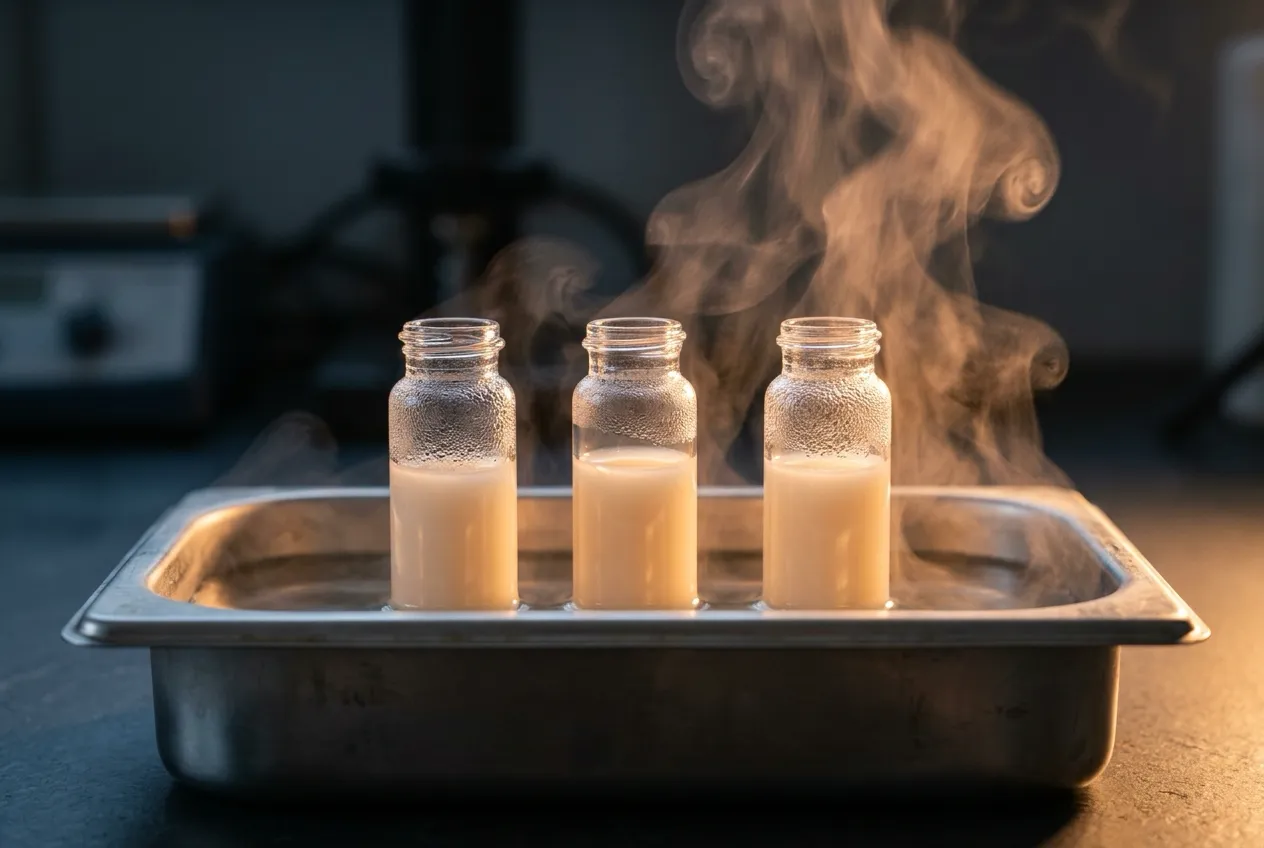
Pasteurized Akkermansia muciniphila is a strange thing to put in a capsule. It is a gut bacterium that has been heated until it is dead, and in the first human trial to test the living and the heat-killed forms side by side, the dead one improved people’s metabolism while the living one did nothing you could measure.
That should unsettle anyone who assumes a probiotic has to be alive to work. Akkermansia is not an ordinary probiotic to begin with. It lives buried in the mucus lining your gut, it makes up a few percent of the bacteria in a healthy colon, and it runs thin in people with obesity and type 2 diabetes. The obvious experiment was to put it back and watch.
What happened is more interesting, and a good deal narrower, than the labels suggest.
What Is Pasteurized Akkermansia Muciniphila?
Akkermansia muciniphila is a species of bacteria that specialises in eating mucin, the protein that makes up your gut’s mucus barrier. Rather than stripping that barrier, its feeding seems to prompt your cells to build more of it, which is part of why a thick Akkermansia population tracks with a healthier gut lining and steadier blood sugar. When people are metabolically unwell, their Akkermansia levels are usually low.
Pasteurized simply means the bacteria were warmed until they could no longer reproduce. You would expect that to destroy any benefit. It does not, and the leading explanation is a protein on the outer membrane called Amuc_1100, which holds its shape through mild heat and appears to do much of the signalling on its own. A dead cell carrying an intact surface protein still talks to the gut lining. That is what makes this a postbiotic, an inactivated microbe or its parts, rather than a conventional live probiotic.
The Science: What Pasteurized Akkermansia Muciniphila Can Actually Do
Four human trials carry most of the weight here. One proved the concept, one showed a practical use, two exposed the catch that decides whether any of it applies to you, and the last found something nobody was looking for.
The proof of concept that started it
The trial that launched the whole field was small and honest about being small.
- The Evidence: A randomized, double-blind pilot enrolled 40 overweight, insulin resistant adults, 32 of whom finished, and gave them live Akkermansia, pasteurized Akkermansia, or placebo at about 10 billion cells a day for three months. The pasteurized group improved insulin sensitivity by roughly 29 percent (P = 0.002), dropped fasting insulin by about 34 percent (P = 0.006), and lowered total cholesterol by about 9 percent (P = 0.02), with a small non-significant nudge down in body weight and fat mass. The live bacteria did not separate from placebo on any of it.
- Read the study: Supplementation with Akkermansia muciniphila in overweight and obese human volunteers: a proof-of-concept exploratory study
Read that last sentence twice, because it is the reason almost every trial since has used the dead form. This was exploratory work, not a verdict, but the direction was clear and the head-to-head comparison was the part worth keeping.
Keeping weight off after a diet
The most practical result is not about losing weight, it is about not gaining it back.
- The Evidence: In a 2026 controlled trial, 90 adults with overweight or obesity first spent eight weeks on a low-energy diet, then twenty-four weeks eating freely while taking pasteurized Akkermansia MucT or placebo. Over the maintenance stretch the Akkermansia group regained 1.2 kg against 3.2 kg on placebo (P = 0.012), and ended with a larger net loss from where they started (P = 0.009).
- Read the study: Pasteurized Akkermansia muciniphila MucT for weight loss maintenance in people with overweight and obesity: a controlled randomized trial
The gap is real but modest, a couple of kilograms across half a year. It is the kind of edge that matters over time without being the transformation an ad would promise.
It works best if you were short of it to begin with
Here is the finding that turns this from a general recommendation into a conditional one.
- The Evidence: A trial in 142 adults with metabolic syndrome gave 30 billion cells a day of pasteurized Akkermansia MucT for four months. The main endpoint, whole-body insulin sensitivity, did not budge across everyone who took it. Only the subgroup who started with low gut Akkermansia saw the improvements, in insulin sensitivity, GLP-1 release, body weight, and trunk fat.
- Read the study: Effect of pasteurized Akkermansia muciniphila MucT on insulin sensitivity, body composition, and GLP-1 production in subjects with metabolic syndrome
- The Evidence: A separate trial in 58 adults with overweight or obese type 2 diabetes found the same pattern with a live strain. People with low baseline Akkermansia colonised well and saw drops in weight, fat mass, and HbA1c, while those who already carried plenty colonised poorly and gained nothing.
- Read the study: Akkermansia muciniphila supplementation in patients with overweight or obese type 2 diabetes: efficacy depends on its baseline levels in the gut
This is the honest headline. Averaged across a mixed group, Akkermansia can look like it does very little. Split the group by how much they had at the start and the benefit concentrates in the people who were running low. It is the same skeptical read that deflates the viral nattokinase plaque number once you sit it next to its one real trial: a supplement can be genuinely useful for a narrow group and unremarkable for everyone else.
An unexpected result on muscle strength
The strangest finding has nothing to do with blood sugar.
- The Evidence: A 12-week trial randomized 100 adults aged 60 and over to a pasteurized Akkermansia strain called HB05 at 10 billion cells a day or placebo. The treated group improved peak torque in the leg extensor muscles (P = 0.0103) and raised blood levels of follistatin (P = 0.0063), a protein that blocks the muscle-limiting signal myostatin.
- Read the study: Pasteurized Akkermansia muciniphila HB05 improves muscle strength and function: a 12-week randomized, double-blind, placebo-controlled clinical trial
Treat this as a lead, not a conclusion. It is one trial, on a different strain, run with involvement from the company that makes the ingredient. Interesting enough to mention, not settled enough to buy Akkermansia for your legs.
A Practical Guide: How to Use It
The first thing to sort out is which form you are actually buying. The cleaner metabolic evidence sits with the pasteurized, postbiotic preparations. The product most people can get, and the one linked here, is a live strain delivered in an acid-resistant, delayed-release capsule with a little prebiotic inulin. Akkermansia is oxygen-sensitive and fragile through the stomach, so that delivery system is doing real work, the same survival problem that decides whether bovine colostrum’s antibodies reach the gut intact. Just know that a live capsule is a slightly different bet than the heat-killed trials, and the direct comparison so far favoured the dead form.
On dose, the trials clustered around 10 billion cells a day, with the larger metabolic syndrome study at 30 billion. Take it daily, with or without food, and give it months rather than weeks. Every trial that found anything ran between 12 weeks and six months, so patience is part of the protocol.
Safety and Advice
Across the human trials Akkermansia was well tolerated, with no serious adverse events tied to it. The common experience is mild and short: a few days of extra gas or looser stools as the gut adjusts.
The people who should check with a doctor first are the usual ones for anything that touches metabolism. If you take medication for type 2 diabetes, Akkermansia works on the same glucose and GLP-1 machinery, so it is worth a conversation rather than a solo experiment. Anyone pregnant, breastfeeding, or immunocompromised should also ask before starting a live bacterial product. And to be plain about it, this is not a treatment for diabetes or obesity. It is a possible small adjunct to the diet, sleep, and movement that do the real work.
The Bottom Line
Pasteurized Akkermansia muciniphila is one of the few supplements where killing the active ingredient makes it work better, and the human data behind it is real but tightly bounded. It helps most in people who start low, it protects a couple of kilograms of lost weight rather than melting fat, and the cleanest results come from the dead form even though the shelf mostly sells the live one.
If your Akkermansia is likely low, which is to say if you carry metabolic weight, it is a reasonable, low-risk thing to try for three to six months alongside the basics, with your expectations set to modest. If you are already healthy and lean, the evidence says to save your money.
This article is for educational purposes only and is not medical advice. Supplements can interact with medications and health conditions, so talk to a qualified healthcare provider before starting anything new.
Common questions
Is pasteurized Akkermansia really better than the live bacterium?
In the one trial that tested both, yes. Depommier and colleagues gave overweight, insulin resistant adults either live or heat-killed Akkermansia for three months, and only the pasteurized form improved insulin sensitivity and cholesterol over placebo. The living version did not separate from placebo. Most human trials since have used the pasteurized form for that reason.
What dose of Akkermansia did the studies use?
The metabolic trials used about 10 billion cells a day, and the larger metabolic syndrome trial used 30 billion. The muscle strength trial in older adults also used 10 billion. Studies ran from 12 weeks to 6 months, so this is not a supplement that shows anything in a week.
Who is most likely to benefit from Akkermansia?
People who are low in it to begin with. Across several trials, the metabolic improvements appeared mostly in participants with low baseline Akkermansia and faded or vanished in those who already had plenty. That usually means people with obesity, type 2 diabetes, or metabolic syndrome rather than healthy adults.
Is Akkermansia safe to take?
In the human trials it was well tolerated with no serious side effects, and some people notice mild digestive changes in the first week. If you take diabetes medication, are pregnant, or are immunocompromised, ask your doctor first, since it acts on the same glucose and GLP-1 pathways as some drugs.