Does Colostrum IgG Survive Stomach Acid? About a Fifth Does
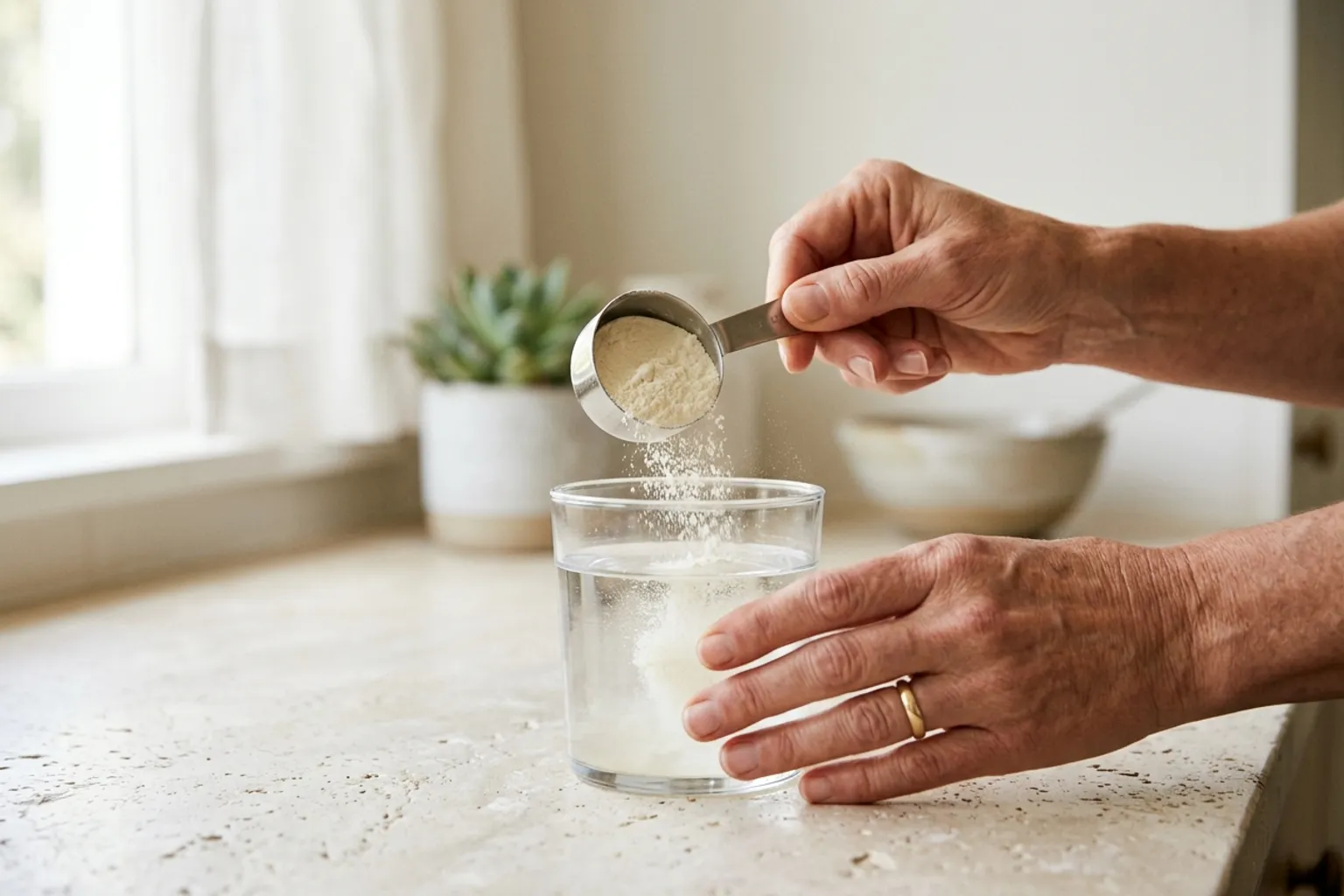
Every colostrum label leads with how much immunoglobulin is packed into a serving, and the number is always impressive. Almost nobody asks the question that decides whether it means anything: does colostrum IgG survive stomach acid, or does it get taken apart like any other protein long before it reaches the part of the gut where it might matter?
There is a clean human answer, and it is more interesting than either side of the marketing lets on. Bovine IgG really is unusually tough to digest. It also mostly does not survive. Both of those are true at once, and holding them together is the whole point here.
What Is Bovine Colostrum?
Colostrum is the first milk a cow produces in the days after giving birth, before regular milk comes in. It is dense with immunoglobulins, the antibody proteins a newborn calf needs because it is born with almost no immune defenses of its own. The dominant one is immunoglobulin G, or IgG, and a colostrum supplement is essentially that first milk dried into a powder and standardized to a stated IgG percentage.
The idea behind taking it is straightforward. IgG is an antibody, so in principle it can bind bacteria, viruses, and their toxins inside the gut, and it may help support the single layer of cells that lines the intestine and decides what gets through. But an antibody is a large, folded protein, and your digestive tract exists to break proteins into their building blocks. Stomach acid unfolds them and enzymes cut them apart. So the mechanism only works if the IgG is still intact and still shaped like an antibody by the time it arrives. That survival question is the one worth answering before anything else, and it is the same “did the active ingredient actually make it” problem that turns up with whether an oral glutathione capsule reaches your bloodstream in one piece.
The Science: Does Colostrum IgG Survive Stomach Acid?
Two human studies do most of the work here. One measured exactly how much IgG makes it through the gut. The other asked whether that surviving fraction does anything you can measure. Read as a pair, they give a grounded answer rather than a hopeful one.
How much IgG actually makes it through
- The Evidence: Seven healthy adults each drank 400 mL of a bovine immunoglobulin concentrate that had been labeled with a nitrogen isotope so it could be tracked. A tube collected the effluent at the end of their small intestine over the next 8 hours. By that point, about 19 percent of the IgG and 19 percent of the IgM were still immunologically active, meaning still recognizable as working antibodies. No IgA was detectable at all. Overall, 79 percent of the immunoglobulin nitrogen had been digested, compared with more than 90 percent for ordinary milk proteins.
- Read the study: 15N-labeled immunoglobulins from bovine colostrum are partially resistant to digestion in human intestine
This is the number the whole category rests on, and it points in both directions. Bovine IgG is genuinely more resistant to digestion than the casein and whey around it, which is the grain of truth under the marketing. And even so, roughly four fifths of it is gone by the end of the small intestine. The IgA is gone entirely. So the honest reading is not “colostrum antibodies are destroyed” and not “they sail through untouched.” A modest, measurable minority survives, and that is the fraction any real effect has to come from.
Does the surviving IgG change anything?
- The Evidence: A 2024 meta-analysis pooled ten randomized trials of bovine colostrum and looked at gut permeability, the leakiness of the intestinal barrier. Colostrum lowered the 5-hour urinary lactulose to rhamnose ratio, a standard leakiness marker, with a mean difference of -0.24 (95 percent CI -0.43 to -0.04). It also nudged down the lactulose to mannitol ratio. It had no effect on plasma I-FABP, a marker of damage to the gut-lining cells themselves.
- Read the study: Bovine Colostrum in Increased Intestinal Permeability in Healthy Athletes and Patients: A Meta-Analysis of Randomized Clinical Trials
A significant result across ten trials is worth something, and it lines up with the survival data: the surviving IgG and other colostrum factors act locally, in the gut, which is exactly where you would expect a protein that never reaches the bloodstream to work. But there is a large caveat that the headline hides. The trials disagreed with each other enormously. On that main permeability marker the heterogeneity was 99 percent, which in plain terms means the studies were almost pulling in different directions, and the pooled number is an average of results that do not really belong in the same bucket. Different populations, doses, and durations produced different answers. The direction of the effect is believable. The size of it is not settled, and anyone quoting a precise figure is overreading the data.
A Practical Guide: How to Use It
The survival data changes how it makes sense to take this, so start there. Because only a fraction of the IgG gets past digestion, the IgG content on the label is a starting amount, not a delivered dose. A product standardized to a stated IgG percentage, like the 20 percent one here, at least tells you what you are starting with, which many cheaper colostrum powders do not.
There is no validated dose, and that is not a detail to gloss over. The permeability trials ran across a wide spread of amounts and lengths, which is part of why their results were so hard to reconcile. So the practical move is to follow the label, take it every day, and treat it as something you judge over weeks. Nothing in the human data supports the idea of a loading dose you feel quickly.
Timing is a minor lever. Some people take colostrum away from very hot drinks and separate from a large protein meal on the theory that less competing digestion leaves more IgG intact, though this is reasoning from the mechanism rather than something the trials tested. If your interest is the gut barrier specifically, that is the outcome with the most direct evidence, thin as it is. The broader immune claims stacked on colostrum labels are not what these particular studies measured. For gut and cellular defenses there are better studied routes, such as prompting your own cells through the Nrf2 pathway that sulforaphane activates.
Safety and Advice
Bovine colostrum is a dairy product, so the clearest rule is the simplest one: if you have a milk or dairy protein allergy, do not take it. It also contains a small amount of lactose, which can bother people who are strongly lactose intolerant, though most colostrum is low enough in lactose to be tolerated.
Beyond that it is generally well tolerated, with mild digestive upset the most common complaint when it happens. The bigger unknowns are around sourcing and processing, since colostrum is an animal product and quality varies between manufacturers. Pregnant and breastfeeding people, anyone immunocompromised, and anyone on regular medication should run it past a clinician first, less because of a specific known interaction and more because the human evidence is still thin and industry-shaped. And keep the expectation honest: moving a permeability marker in a trial is not the same as a proven health outcome, and colostrum is not a treatment for any gut disease.
The Bottom Line
Does colostrum IgG survive stomach acid? Partly. About a fifth of it reaches the end of the small intestine still working as an antibody, which makes it tougher than most milk proteins and also means the great majority is digested first. The best human outcome data, on gut permeability, shows a real but unsettled signal, held back by trials that disagree with each other far too much to pin down an effect size.
If you want to try it, buy a product that states its IgG content, take it daily, and give it weeks with clear eyes about how early the evidence still is. It is a plausible gut-barrier support with a genuine mechanism, not the immune miracle the labels imply.
This article is for educational purposes only and is not medical advice. Supplements can interact with medications and health conditions, so talk to a qualified healthcare provider before starting anything new.
Common questions
Does colostrum IgG survive stomach acid?
Partly. In the one human study that measured it directly, about 19 percent of ingested bovine IgG was still immunologically active by the end of the small intestine. That makes it more digestion resistant than most milk proteins, but it also means roughly four fifths of the IgG is broken down before it can do anything.
Does bovine colostrum actually help the gut barrier?
A 2024 meta-analysis of ten trials found colostrum lowered markers of gut leakiness, but the trials disagreed with each other so sharply that the size of the effect is not settled. It is a real signal, not a proven dose response.
How much colostrum should you take?
The permeability trials used a wide range of doses and durations, which is part of why their results are hard to pool. There is no single validated dose, so follow the label, take it daily, and judge it over weeks rather than days.
Who should avoid bovine colostrum?
Anyone with a dairy or milk protein allergy, since colostrum is a milk product. People who are severely lactose intolerant may react to the small amount of lactose. If you are pregnant, immunocompromised, or on medication, check with a doctor first.