What Your Sitting-Rising Test Score Actually Means
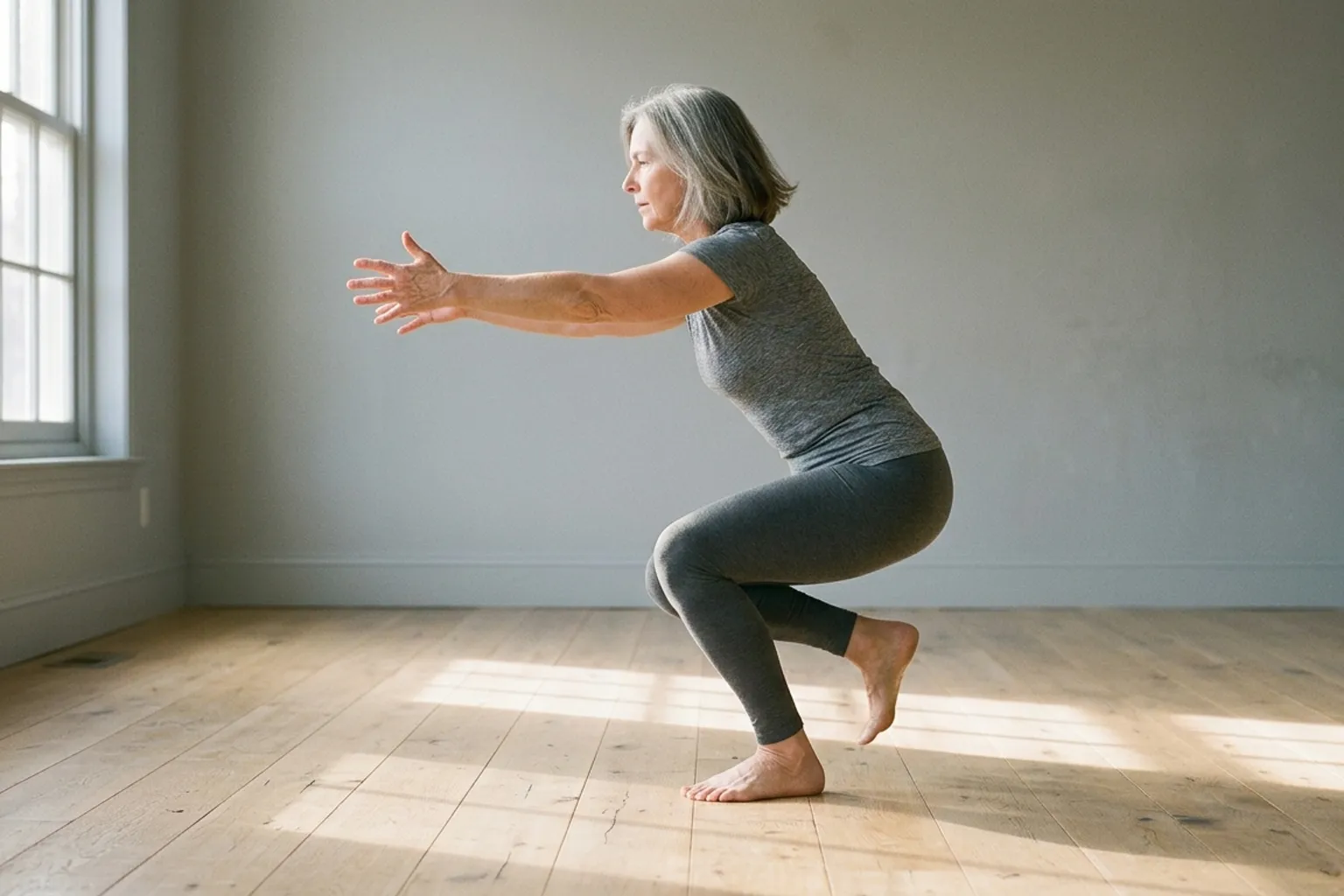
Sit down on the floor and stand back up without a hand, a knee or a wobble, and you have just scored a perfect 10 on the sitting-rising test. What that score means is the part almost every version of this online gets wrong.
The headline you have probably seen is that low scorers are five to six times likelier to die. That figure is real, but it comes from a 2014 study of 2,002 people. The test has since been run again on more than twice as many, followed for twice as long, and the newer answer is smaller and much more interesting.
Here is the actual scale, the actual numbers attached to each band, and the honest size of the effect once you account for the fact that people who cannot get off the floor differ from people who can in about forty other ways.
How the Test Is Scored
You start with five points for sitting down and five for getting back up. One point comes off for each support you use, and the 2025 paper is specific about what counts: a hand, a forearm, a knee, or the side of a leg. Half a point comes off if the person watching judges the movement unsteady. Add the two halves together and you get a score from 0 to 10.
That grading is stricter than most people apply to themselves. Bracing a hand on your own knee is a support. Putting a forearm down on the way to the floor is a support. A visible wobble on the way up costs half a point even if nothing touched the ground.
The distribution is the first thing worth knowing, because it tells you where a given score sits. Among the 4,282 adults in the 2025 study, 10.1 percent scored a perfect 10, 22.2 percent scored 8.5 to 9.5, 27.7 percent scored exactly 8, 29.0 percent scored 4.5 to 7.5, and 10.9 percent scored 4 or below. A score of 8 is the most common single result, not a bad one.
What the test loads is four things at once, and the authors say so plainly: muscular strength and power, flexibility, balance, and body composition. That is the reason one movement carries so much information. It is also the reason it is hard to interpret, since a low score does not tell you which of the four is failing.
The Science: What Your Sitting-Rising Test Score Means
Every point down the scale costs something
- The Evidence: A prospective cohort of 4,282 adults aged 46 to 75, 68 percent of them men, was assessed at a private exercise medicine clinic in Rio de Janeiro between July 1998 and December 2023, then followed for a median of 12.3 years (interquartile range 7.6 to 18.0). Deaths from COVID-19 and external causes were excluded before analysis, leaving 665 natural-cause deaths, or 15.5 percent of the group. Death rates ran 3.7 percent for a score of 10, then 7.0, 11.1, 20.4 and 42.1 percent down through the bands to a score of 4 or less, with a continuous trend at P below 0.001.
- Read the study: Sitting-rising test scores predict natural and cardiovascular causes of deaths in middle-aged and older men and women
The gradient is the persuasive part, and it is the part the viral version of this always drops in favour of the two endpoints. Risk does not sit flat across the middle of the scale and then fall off a cliff at the bottom. It climbs at every step, including between a 10 and an 8.5, which are movements that look nearly identical from across a room.
The size of the effect, once you adjust for everything else
- The Evidence: In the same cohort, Cox models adjusted for age, sex, body mass index and clinical variables put the lowest scorers at a hazard ratio of 3.84 (95% CI, 2.25 to 6.97) for natural-cause death and 6.05 (95% CI, 2.29 to 20.94) for cardiovascular death, against those scoring a perfect 10.
- Read the study: Sitting-rising test scores predict natural and cardiovascular causes of deaths in middle-aged and older men and women
Divide the raw death rates and you get 42.1 against 3.7, an elevenfold gap. Adjustment cuts that to 3.84. Both numbers are in the same paper, and the smaller one is the one to quote, because the people who scored 0 to 4 were older, heavier and sicker before they ever sat down on the floor.
Look closely at the cardiovascular figure too. The point estimate is 6.05, but the confidence interval runs from 2.29 to 20.94. An interval that wide is telling you the study had very few cardiovascular deaths at the extremes of the score range. The direction is solid. The magnitude is close to unknown.
The number going around comes from the older, smaller study
- The Evidence: The 2014 paper that made the test famous studied 2,002 adults aged 51 to 80 over a median 6.3 years, during which 159 died. Adjusting only for age, sex and body mass index, it reported a hazard ratio of 5.44 (95% CI, 3.1 to 9.5) for the lowest scorers against the highest, and calculated that each single point of score was worth a 21 percent improvement in survival.
- Read the study: Ability to sit and rise from the floor as a predictor of all-cause mortality
That 5.44 is where “five to six times” comes from, and you will find it on Wikipedia, in newspapers, and in most of the fitness content about this test. It is not wrong. It is just the weaker estimate: a third of the follow-up, half the sample, and an adjustment set that leaves out existing disease entirely. When a bigger, longer study with better controls returns a smaller number, the smaller number is the one that has survived more scrutiny.
It is one clinic, and that is the real limitation
Everyone in both studies walked into the same private practice in Rio de Janeiro and asked to be evaluated. The authors are direct about what that costs them: participants were highly motivated, mostly from the upper socioeconomic and education strata of the country, and the extrapolation of the findings to other populations is uncertain.
More importantly, the study has no data on physical activity. None. A test that measures strength, flexibility, balance and body composition is going to pick up how much somebody moves, and how much somebody moves is one of the best-established predictors of mortality there is. That confound was never adjusted for, and it is the one that would most reduce the effect if it had been. Medication and laboratory data were also unavailable, and smoking status was missing for part of the sample.
This is the same problem that runs through the Finnish sauna cohort and its 40 percent mortality figure: a large, real, repeatedly measured association from people who chose their own habits, with no trial behind it.
A Practical Guide: How to Take It, and What a Low Score Is Worth
Do it next to a sofa or a wall you can grab, on a floor you do not mind landing on. In the study a physician or nurse watched every attempt. Nobody was hurt, but everyone in the cohort had already been screened as having no relevant physical or clinical limitation, which is not true of everyone reading this. If you are unsteady, have had a recent fall, or have a hip or knee that gives way, do this with someone in the room or skip it.
Score yourself honestly. Film it on a phone if you want the half-point deductions to be real, because the wobble is the part people forgive themselves for.
Then treat a low score as information about what to work on, not as a verdict. The four things the test loads all respond to training, and none of them respond to practising the test itself. Strength and power are the components most people lose first, and creatine is the one supplement with enough human data to be worth the shelf space there, which is why creatine keeps showing up in the muscle and brain literature. If the limiting factor is how much muscle you have left rather than how hard you can contract it, urolithin A and its effect on mitochondrial function in older adults is the more relevant read. Neither substitutes for getting on the floor a few times a week.
The honest framing: nobody has run the trial where you train people’s sitting-rising score and then count who is still alive. The 2025 paper tests no intervention and makes no claim that it does.
Safety and Advice
The test itself is low risk for people who can already get to the floor, which is precisely the group least likely to learn anything alarming from it. If getting down is the hard part, that is the finding, and you do not need to complete the movement to have your answer.
Do not read a single score as a prognosis. These are group averages over more than a decade, drawn from a self-selected Brazilian cohort, and they say nothing specific about you. A 60 year old with a stiff hip and a 60 year old with early neuropathy can post the same 6 and be in entirely different situations.
If your score dropped noticeably from a year ago, that is worth mentioning to a doctor. The study measured everyone once, so it cannot tell you what a decline means. A change you can feel is still a change worth investigating.
The Bottom Line
The sitting-rising test is a good, free, thirty second read on non-aerobic fitness, and the gradient it produces is real: risk rises at every step down the scale, not just at the bottom. Take it, note the number, and repeat it in a year.
What it is not is a five to six times multiplier on your risk of dying. That figure belongs to a smaller study from 2014 with a thinner set of controls. The better-powered 2025 version says 3.84, still with no adjustment for how much anybody exercises, from a single clinic in Rio. Use the score to decide what to train. Do not use it to predict anything.
This article is for educational purposes only and is not medical advice. Physical tests can carry risk if you have a condition affecting balance, strength or joints, so talk to a qualified healthcare provider before trying anything new.
Common questions
What is a good sitting-rising test score?
Ten out of ten, meaning you got down and back up without a hand, a forearm, a knee or the side of a leg touching down, and without wobbling. In the 4,282 adults aged 46 to 75 in the 2025 study, only 10.1 percent managed it. A score of 8 was the single most common result.
What does a sitting-rising test score of 8 mean?
It puts you in the middle of the distribution and it was linked to an 11.1 percent death rate over a median 12.3 years, against 3.7 percent for a perfect 10. That is an association measured across a whole group, not a prediction about you.
Is the sitting-rising test accurate?
It reliably sorts people by risk, but the widely quoted five to six times figure comes from a smaller 2014 study that adjusted only for age, sex and body mass index. The larger 2025 study, adjusting for clinical variables too, found 3.84 times.
Can you improve your sitting-rising test score?
Almost certainly, since the test loads strength, flexibility, balance and body composition, all of which respond to training. What nobody has shown is that improving the score changes how long you live. No trial has tested that.