Lion's Mane Fruiting Body vs Mycelium: What the Trials Used
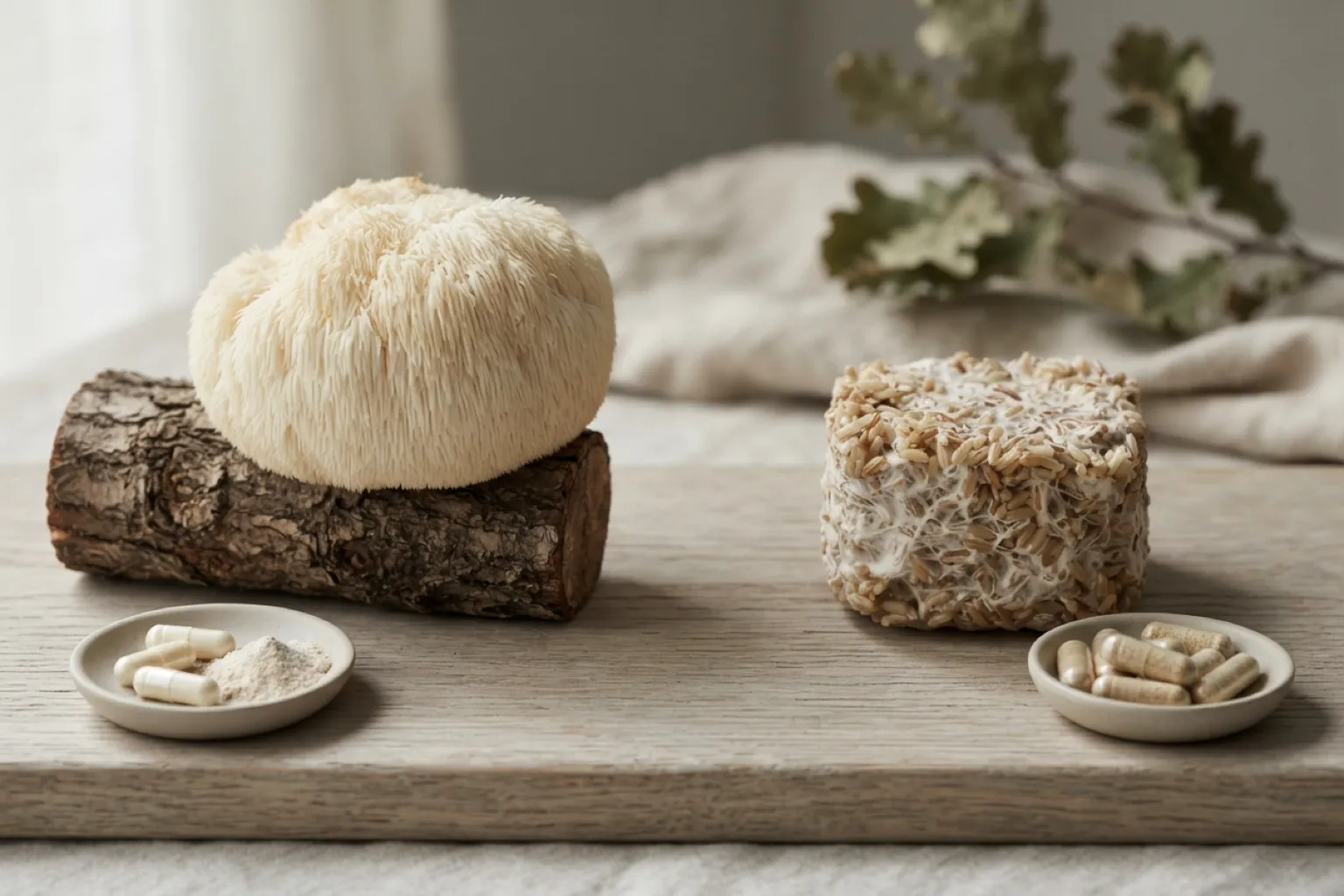
Lion’s mane fruiting body vs mycelium is the first choice you face on the shelf, and plenty of labels make it hard to tell which one you are buying. The fruiting body is the shaggy white mushroom itself. The mycelium is the thread-like network that grows underneath it, and in many supplements it is grown on rice or oats and sold together with the grain it grew on.
This is more than a purity argument. The two parts of the fungus make different compounds, and the handful of human trials each tested one specific form. If you want to copy a result, you have to copy the material.
The trials are also small, and most of them were run or paid for by companies with a product to sell. So the useful question is narrower than “does lion’s mane work”. It is: which form was tested, on whom, and what did it actually change?
What Is Lion’s Mane?
Lion’s mane (Hericium erinaceus) is an edible mushroom that grows on hardwood trees and is eaten as a culinary mushroom, particularly in East Asia. Its interest for the brain comes from two families of small molecules.
Hericenones were isolated from the fruiting body. Erinacines were isolated from the mycelium. A review in Mycology covering the chemistry up to 2009 reported that most of these compounds stimulate the production of nerve growth factor (NGF) in cultured rodent brain cells. NGF is a protein that helps neurons survive and maintain their connections, which is why the mushroom gets marketed for memory.
- Read the review: Hericenones and erinacines: stimulators of nerve growth factor (NGF) biosynthesis in Hericium erinaceus
That is cell work. Nobody has shown that a lion’s mane capsule raises NGF in a living human brain. The human evidence comes from cognitive tests, and that is what follows.
The Science: Lion’s Mane Fruiting Body vs Mycelium in Human Trials
The trials split cleanly by form. The two studies in older Japanese adults used dried fruiting body. The one study in people with Alzheimer’s disease used a mycelium measured for its erinacine A content. The studies in young, healthy adults used fruiting body extracts and found much less.
Fruiting body powder in older adults
-
The Evidence: A double-blind, placebo-controlled trial in Phytotherapy Research randomized 30 Japanese adults aged 50 to 80 with mild cognitive impairment, 15 per group. The lion’s mane group took four 250 mg tablets, each 96 percent dried mushroom powder, three times a day for 16 weeks. On a cognitive scale based on the revised Hasegawa dementia scale, they scored significantly higher than placebo at weeks 8, 12 and 16. Four weeks after stopping, their scores had dropped again. Lab tests showed no adverse effects.
-
The Evidence: A 12 week randomized, double-blind, placebo-controlled trial in Biomedical Research gave adults aged 50 and over with normal cognition tablets of powdered fruiting body. Of the three tests used, only the Mini-Mental State Examination improved. The Benton visual retention test and a verbal paired-associate learning test showed no effect.
-
Read the study: Improvement of cognitive functions by oral intake of Hericium erinaceus
The first trial is the strongest result lion’s mane has, and it is 15 people per arm. The fade after stopping is worth noticing: whatever the mushroom did, it did not last once people stopped taking it. The second trial found a benefit on one test out of three, which is a weak signal.
Erinacine A enriched mycelium in mild Alzheimer’s disease
- The Evidence: A pilot double-blind, placebo-controlled trial in Frontiers in Aging Neuroscience gave patients with mild Alzheimer’s disease three 350 mg capsules a day of mycelium standardized by HPLC to 5 mg of erinacine A per gram, or placebo, for 49 weeks. Over that time, the placebo group’s score on the Cognitive Abilities Screening Instrument fell significantly, the mycelium group’s Mini-Mental State Examination score improved significantly, and the groups differed on a measure of daily living activities. The mycelium group also had better contrast sensitivity. Four people dropped out with abdominal discomfort, nausea or skin rash. Several authors were affiliated with Grape King Bio, the company that makes the ingredient.
- Read the study: Prevention of Early Alzheimer’s Disease by Erinacine A-Enriched Hericium erinaceus Mycelia Pilot Double-Blind Placebo-Controlled Study
This is the trial people point to when they defend mycelium. Look at what was tested, though. It was a mycelium measured and standardized for one specific compound. A typical mycelium on grain product makes no claim about its erinacine A content, so this result tells you nothing about it.
Healthy young adults: small and mixed
-
The Evidence: A randomized, double-blind, placebo-controlled pilot in Nutrients gave 41 healthy adults aged 18 to 45 either 1.8 g a day of a lion’s mane extract (three 600 mg capsules with breakfast) or placebo for 28 days. Sixty minutes after a single dose, the lion’s mane group was faster on the Stroop task (p = 0.005). After 28 days, subjective stress only trended lower (p = 0.051), short of significance, and the authors reported null and some negative findings alongside. The company that supplied the product funded the study.
-
Read the study: The Acute and Chronic Effects of Lion’s Mane Mushroom Supplementation on Cognitive Function, Stress and Mood in Young Adults
-
The Evidence: A crossover trial in Frontiers in Nutrition gave 18 healthy adults aged 18 to 35 a single 3 g dose of a 10:1 fruiting body extract or placebo. There was no overall effect on composite measures of cognition or mood 90 minutes later. One individual test, a pegboard task, improved. A company selling lion’s mane drinks funded it.
-
Read the study: Acute effects of a standardised extract of Hericium erinaceus (Lion’s Mane mushroom) on cognition and mood in healthy younger adults
In people whose memory is already working well, a single dose did very little, and four weeks did not do much more. If you are 30 and hoping for sharper focus, the evidence is thin.
A Practical Guide: How to Use It
Start with the label. Look for the words “fruiting body” or “mycelium”, and watch for “myceliated brown rice”, “myceliated oats” or “full spectrum” with no part named. Mycelium grown on grain is harvested along with the grain, so part of every capsule is cereal starch. A method published in the Journal of AOAC International measures beta-glucan by separately subtracting the starch-type alpha-glucan, which is why a stated beta-glucan figure tells you more than a “polysaccharides” figure. Starch is a polysaccharide too.
- Read the study: Measurement of β-Glucan in Mushrooms and Mycelial Products
Beta-glucan content does not prove a cognitive effect. It is a check on whether you are buying mushroom or mostly grain. The same “did the active part survive the product” question comes up with broccoli sprout supplements and their myrosinase.
On dose, there is no single number to copy, because each trial used different material. The mild cognitive impairment trial used 3 g of dried fruiting body tablets a day, split into three doses. The young adult trial used 1.8 g of extract with breakfast. An extract is concentrated, so its milligrams cannot be swapped for whole powder one for one, and nobody has tested the product linked on this page in a cognitive trial.
Give it time. In the strongest trial, the difference from placebo showed up at week 8 and grew to week 16. Expect any benefit to fade within weeks of stopping. If you are weighing it against other memory supplements, magnesium L-threonate has a similar profile: plausible biology, a few small trials, and most of them funded by sellers.
Safety and Advice
Lion’s mane is a food mushroom, and the trials reported few problems. The 16 week Japanese trial found no adverse effects on lab tests. In the 49 week Alzheimer’s pilot, four people dropped out with stomach discomfort, nausea or a skin rash.
Skip it if you are allergic to mushrooms. The trials did not include pregnant or breastfeeding women, so there is no safety data for them. If you or a family member has a diagnosis of mild cognitive impairment or Alzheimer’s disease, use lion’s mane alongside medical care, never in place of it, and tell the doctor you are taking it.
The Bottom Line
The best lion’s mane results come from small trials in older adults with early memory problems, using either dried fruiting body or a mycelium standardized for erinacine A. In healthy young adults the effects were small or absent. If you want to try it, buy a product that names the fruiting body and states its beta-glucan content, take it daily for at least two to three months, and judge it on whether you notice a difference, knowing the benefit seems to stop when you do.
This article is for educational purposes only and is not medical advice. Supplements can interact with medications and health conditions, so talk to a qualified healthcare provider before starting anything new.
Common questions
Is lion's mane fruiting body or mycelium better?
They contain different compounds. Hericenones were isolated from the fruiting body and erinacines from the mycelium. The two trials in older Japanese adults used fruiting body powder, and the one mycelium trial used a mycelium tested for its erinacine A content, which ordinary mycelium on grain products do not state.
How much lion's mane per day did the studies use?
The trial in adults with mild cognitive impairment used four 250 mg tablets of dried fruiting body three times a day, 3 g in total. A trial in young adults used 1.8 g of extract a day, and the Alzheimer's pilot used three 350 mg capsules of erinacine A enriched mycelium.
How long does lion's mane take to work?
In the mild cognitive impairment trial, scores were higher than placebo from week 8 and kept rising to week 16. They fell again within four weeks of stopping, so any benefit seems to last only while you take it.
Does lion's mane have side effects?
The trials reported few. In the 49 week Alzheimer's pilot, four people dropped out with stomach discomfort, nausea or a skin rash. Anyone with a mushroom allergy should avoid it.